My favorite sport is swimming.
Come summer, I swim in the pool every day.
But I don't watch a swimming races on TV. I am not interested that much.
But I like to play in the water. When I swim, I feel that the flow of the water feels good and I can forget about my daily life because, in the water, I don't hear the noisiness around me. It heals me.
An important thing, though, is not to drown. Because the first thing, living is important.
Monday, December 2, 2013
My Favorite Sport (SJ: 12/02)
三年生 - Elective

Wednesday, November 27, 2013
The Other's Other
A few months ago, after the gold medal match of the World Cup of Softball between USA and Japan, ESPN commentator, Michelle Smith, was heavily chastised for a stereotypical "rice and sushi" joke about a Japanese fan in the stands dressed in a happi coat, which, to be fair, is the standard uniform for men in traditional 和風 related fields, today most commonly found in Japanese dining.
While I actively advocate for the necessity of pointing out individual behaviors and complex systems that perpetuate racial assumptions, I wondered how the dynamic is altered if the appropriated culture, itself, participates in the perpetuation of its own stereotypes.
Because stereotypes have the power to flatten cultures into homogeny, Japanese culture, which has a history of eschewing roughness in favor of uniformity, has become a society which happily trades and is heavily invested in its own stereotypes. It is no accident that ideas of "sushi" and "samurai," "geisha" and "ninjas," robots and technology are quintessentially "Japanese." Even though many households still lack computers, the Japanese, themselves, would say these things to you, even without your asking. Much of the uncritical, national-personal identity is tied up in ideological "samenesses," not limited to appearance, taste or personal philosophies.
But then, of course, such broad, sweeping statements as the one above are flattening and problematic as they don't take into account individual dynamics.
But when those self-same individuals appear invested in these stereotypes for their identity, especially ones that create and perpetuate differences from other local cultures, how much are we to blame as outsiders for participating in those artificial binaries?
Japanese Americans have long benefitted in trading in traditional American-minority stereotypes. As a secondary group of non-indigenous "others" in an otherwise standard majority-minority binary, Asians come out ahead of blacks by merely being a contrasting difference
Taking advantage of the existence of a contentious white-black binary, Asians submitted themselves as an accommodating “model minority"; a triangulating pole against which blacks are judged as a problematic, failing minority group; “proof” that the hegemonic system worked.
This tension between minority "brotherhoods" grows even more when, because of the aforementioned fluidity of their otherness, Asians access and perpetuate culturally flattening black-stereotypes as emotional shortcuts to signify toughness, non-conformity, and, most heinously, solidarity, all of which exists outside of the Asian American reality because of their willful submission to the patriarchy.
It is no surprise, then, that Asian culture groups are in no hurry to overturn systemic racism, lest they put at risk the benefits they reap from being the other's other. And it is no wonder why other minority groups that suffer less favorably have little patience with their Japanese (and Chinese and Korean) counterparts.
But, regardless, cultural appropriation stings equally across races, as Katy Perry's performance at the November 2013 American Music Awards reminds. Appropriation, here, is when aspects of cultural customs and heritages are ripped from their cultural contexts in the service of pandering to larger stereotypes. In this instance, Katy Perry, in order to communicate the beauty of unconditional devotion and self-sacrificial submission, took from the Japanese the Maiko/Geisha, the embodiment of the Yamato Nadeshiko, the delicate floral metaphor of the ideal, pure female beauty, demure and unobtrusive, as codified in the Heian period as part of the 大和魂, the innate, indigenous aspects of true Japanese spirit, the traits that make up the very soul of Japan.
Perry's appropriation of Maiko and the Yamato Nadeshiko is problematic because it subjects Japanese (nee, Asian) women to a sexist, patriarchal submissive ideal, reducing their value to servility and beauty.
But to accuse Perry of appropriation feels a bit disingenuous when Japan still readily trades in such stereotypes. In thinking forward to the 2020 Tokyo Olympics, I have a hard time imagining that their Opening Ceremony wouldn't be much different than what was shown here. After all, famous in Japan
In many ways, it is easy to see how japan benefits domestically by perpetuating these stereotypes. But more importantly, as Japan has historically been afforded the unique position to control the terms of substantial portions of its own international image through exclusion and mystery, by investing and targeting specific stereotypes to emphasize, Japan has colored in its own paint-by-numbers narrative to positively contrast with the countries in its area.
Though the Japanese drink as much if not more than their closest neighbors, it's the Koreans who are seen as wild partiers. Though Japan heavily squanders energy on inefficiently recycling waste plastics for packaging and wrapping, they are thought of as clean and environmentally friendly in contrast to the Chinese. And while the mob-run gambling and sex-trade flourish throughout Japan, it's Tokyo, not Bangkok or Manila, that's "safe" and "free from corruption."
By holding tightly onto monolithic, hegemonic institutions, Japan has established itself as a stable cultural state, the icon of thousands of years of history and tradition, despite actually being much younger than its Chinese, Korean and even Southeast Asian neighbors. This despite the fact that many of the images we have of Japan weren't established until the Meiji Restoration in 1868.
On the one hand, it seems perfectly reasonable for people, like Perry, to reiterate the narrative pieces she hears, especially when they appear to come from credible sources
The other day, a friend and I met an international student over coffee. Over the course of normal conversation we came to find out he was from Senegal. In a later debriefing about our interaction, it came to light that my friend had plenty of questions he wanted to ask the international student about his home life and his family, but my friend was unsure about whether the questions he wanted to ask were insensitive or ignorant because of our general American unfamiliarity with all-things-Africa.
I affirmed that this was probably the best course of action in this situation. But that, were we to meet our new friend a second time, such persistent ignorance could be seen as nothing short of willful and offensive in its indifference.
Everybody deserves at least that much, right?
While I actively advocate for the necessity of pointing out individual behaviors and complex systems that perpetuate racial assumptions, I wondered how the dynamic is altered if the appropriated culture, itself, participates in the perpetuation of its own stereotypes.
Because stereotypes have the power to flatten cultures into homogeny, Japanese culture, which has a history of eschewing roughness in favor of uniformity, has become a society which happily trades and is heavily invested in its own stereotypes. It is no accident that ideas of "sushi" and "samurai," "geisha" and "ninjas," robots and technology are quintessentially "Japanese." Even though many households still lack computers, the Japanese, themselves, would say these things to you, even without your asking. Much of the uncritical, national-personal identity is tied up in ideological "samenesses," not limited to appearance, taste or personal philosophies.
But then, of course, such broad, sweeping statements as the one above are flattening and problematic as they don't take into account individual dynamics.
But when those self-same individuals appear invested in these stereotypes for their identity, especially ones that create and perpetuate differences from other local cultures, how much are we to blame as outsiders for participating in those artificial binaries?
Japanese Americans have long benefitted in trading in traditional American-minority stereotypes. As a secondary group of non-indigenous "others" in an otherwise standard majority-minority binary, Asians come out ahead of blacks by merely being a contrasting difference
1Simply by not being first, but also, importantly, as non-diasporic, financially and culturally affluent expatriates
1. Like trying to locate a third color in a binary gradient, "yellow" fits fluidly between similarity and dissimilarity because while it is not "pure white," it also passes as definitely "not black."Taking advantage of the existence of a contentious white-black binary, Asians submitted themselves as an accommodating “model minority"; a triangulating pole against which blacks are judged as a problematic, failing minority group; “proof” that the hegemonic system worked.
This tension between minority "brotherhoods" grows even more when, because of the aforementioned fluidity of their otherness, Asians access and perpetuate culturally flattening black-stereotypes as emotional shortcuts to signify toughness, non-conformity, and, most heinously, solidarity, all of which exists outside of the Asian American reality because of their willful submission to the patriarchy.
It is no surprise, then, that Asian culture groups are in no hurry to overturn systemic racism, lest they put at risk the benefits they reap from being the other's other. And it is no wonder why other minority groups that suffer less favorably have little patience with their Japanese (and Chinese and Korean) counterparts.
But, regardless, cultural appropriation stings equally across races, as Katy Perry's performance at the November 2013 American Music Awards reminds. Appropriation, here, is when aspects of cultural customs and heritages are ripped from their cultural contexts in the service of pandering to larger stereotypes. In this instance, Katy Perry, in order to communicate the beauty of unconditional devotion and self-sacrificial submission, took from the Japanese the Maiko/Geisha, the embodiment of the Yamato Nadeshiko, the delicate floral metaphor of the ideal, pure female beauty, demure and unobtrusive, as codified in the Heian period as part of the 大和魂, the innate, indigenous aspects of true Japanese spirit, the traits that make up the very soul of Japan.
Perry's appropriation of Maiko and the Yamato Nadeshiko is problematic because it subjects Japanese (nee, Asian) women to a sexist, patriarchal submissive ideal, reducing their value to servility and beauty.
But to accuse Perry of appropriation feels a bit disingenuous when Japan still readily trades in such stereotypes. In thinking forward to the 2020 Tokyo Olympics, I have a hard time imagining that their Opening Ceremony wouldn't be much different than what was shown here. After all, famous in Japan
2"Japan-famous."
2 is Christel Takigawa's "Omotenashi" speech, used as the centerpiece of Tokyo's Olympic bid package, which, itself, has become more famous here because it is a pandering, pan-Asian mish-mash of koans (公安) and hand-gestures3Spoiler alert: nobody bows like that here. And Christel does it twice in her 2 minute speech.
3 that spoke more to the orientalist constructs the IOC expected to see. In many ways, the entire Tokyo Olympic bid was a formal presentation of the post-apocalyptic, simulacrum-Tokyo that Tokyo (and its people) doesn't just aspire to be but actually believes itself to be. These images become powerful unifying forces that help give Tokyo (and all of Japan) a sense of grandeur, of purpose. But also smashes everybody into a seemingly faceless one-ness and interchangeability.In many ways, it is easy to see how japan benefits domestically by perpetuating these stereotypes. But more importantly, as Japan has historically been afforded the unique position to control the terms of substantial portions of its own international image through exclusion and mystery, by investing and targeting specific stereotypes to emphasize, Japan has colored in its own paint-by-numbers narrative to positively contrast with the countries in its area.
Though the Japanese drink as much if not more than their closest neighbors, it's the Koreans who are seen as wild partiers. Though Japan heavily squanders energy on inefficiently recycling waste plastics for packaging and wrapping, they are thought of as clean and environmentally friendly in contrast to the Chinese. And while the mob-run gambling and sex-trade flourish throughout Japan, it's Tokyo, not Bangkok or Manila, that's "safe" and "free from corruption."
By holding tightly onto monolithic, hegemonic institutions, Japan has established itself as a stable cultural state, the icon of thousands of years of history and tradition, despite actually being much younger than its Chinese, Korean and even Southeast Asian neighbors. This despite the fact that many of the images we have of Japan weren't established until the Meiji Restoration in 1868.
On the one hand, it seems perfectly reasonable for people, like Perry, to reiterate the narrative pieces she hears, especially when they appear to come from credible sources
4i.e. the Japanese themselves.
4. And, when lacking in exposure, ignorance is understandable. But at what point do we start holding people accountable for their ignorance? The other day, a friend and I met an international student over coffee. Over the course of normal conversation we came to find out he was from Senegal. In a later debriefing about our interaction, it came to light that my friend had plenty of questions he wanted to ask the international student about his home life and his family, but my friend was unsure about whether the questions he wanted to ask were insensitive or ignorant because of our general American unfamiliarity with all-things-Africa.
I affirmed that this was probably the best course of action in this situation. But that, were we to meet our new friend a second time, such persistent ignorance could be seen as nothing short of willful and offensive in its indifference.
Everybody deserves at least that much, right?
Tuesday, November 19, 2013
Land of Opportunity
I always intend to go to bed as early as possible. Sleeping may just be one of my favorite things in the world, followed closely only by things like "eating" and "pooping."
But the best-laid schemes o' mice an' men, as they say, gang aft agley. And with the likes of Maru, Stack-cat and Nya-Suke on YouTube, I really have no chance of getting to bed before midnight.
Things never go quite as planned. This is especially true when you’re relying on other people’s motivation for success.

A few weeks ago, 2A-Oral Communication left for their Language Training excursion in Torrance, CA. And every week leading up to that since mid-spring, Kashew and I were tasked to provide the students with conversational and cultural instruction that would be beneficial to their experience in America. And though, early on, because the trip seemed so far off in the future, they would struggle to pay any attention to what we had to say, by the time it dawned on them that they would actually be flying to America, they felt under-prepared and overwhelmed by the burden of international travel and cross-cultural interaction.
Over and over again, the students would tell us that they were embarrassed that they could not speak English like a native speaker, that they were afraid that the Americans would think that they were dumb and ignorant about many facets of American culture.
We would listen patiently, nodding in understanding, having shared acutely our own daily experience with the very stress they dread, from shopping at the convenience store, to ordering dinner, to getting haircuts, or trying to schedule weekend activities. No matter how much Japanese we learn, no matter how Japanese we may feel, there are always aspects of Japanese culture that we are not yet privy to, in a way that makes cross-cultural understanding seem more like sifting through quicksand than checking off lessons listed in a textbook.
But, on the other hand, I want to yell at them. What they were dreading was the prospect of being uncomfortable, the mere "likelihood" of misunderstanding. Firmly rooted in their fear of unknowing, I want to shake them out of their risk-adverse hesitancy because, guess what: Surprise!, they aren't native English speakers and, double surprise!, they don’t know anything about American culture. And double-plus surprise!, their host families already know that.
But, as such, we tell them that this is their golden opportunity to 遠慮しない, to act without reservation. That while international travel is scary and cross-cultural exchange is intimidating, a study-abroad trip is the time to explore those scary and intimidating things with as little risk as possible because everyone there knows you came to learn. So there is no shame in ignorance. There is no shame in not knowing. Because you came to learn.
So if they have a question, they should feel free to ask it. If they have a curiosity, they should feel free to explore it. Ask freely, explore freely: the host families sighed up because they want to share their culture as much as they want to learn about Japan.
So that should be our target framework.
One thing that I wanted Kashew to be conscious of as we designed our 2A prep classes is that our goal should be to remove the barriers that the 2A students may face when going to America. We want to facilitate the cultural exchange experience. So whether that be by lowering stress levels by teaching students how not to get lost or "randomly selected" for inspection by TSA at the airport, or teaching them about refrigerator rights or how Americans join the toilet room and the shower room in one, all-encompassing mega-room called the "bathroom," our target is to prepare them for their stay with their host families, because it is their experience with their host families that will teach them more about culture and the value of exchange than we ever could.
We want to facilitate the cultural exchange experience, not replicate it or replace it.
Rather, I believe that if we teach them everything there is about American schools and American eating habits before they leave for America, we're taking valuable exchange experiences away from our students and their host families.
I don't care so much to give them the answers to all of the questions about America before they get there. What I want to teach them before they go is how to ask those questions of their host families and then have to be asked those same questions of themselves.
So we teach them how to talk about their opinions and express their desires. We have them practice how to ask and then listen to the answers. We show them some of the things they will see and do in the hopes that they will start thinking about what they will experience and what they can talk about. All in an attempt to reframe their approach to the exchange program from "risk" to "opportunity."
But no matter how many times we yell at them not to be afraid to take the chance and use their English, that is a decision that they have to make. One we hope they decide to make before they go to America, and not on their way back.
But the best-laid schemes o' mice an' men, as they say, gang aft agley. And with the likes of Maru, Stack-cat and Nya-Suke on YouTube, I really have no chance of getting to bed before midnight.
Things never go quite as planned. This is especially true when you’re relying on other people’s motivation for success.
A few weeks ago, 2A-Oral Communication left for their Language Training excursion in Torrance, CA. And every week leading up to that since mid-spring, Kashew and I were tasked to provide the students with conversational and cultural instruction that would be beneficial to their experience in America. And though, early on, because the trip seemed so far off in the future, they would struggle to pay any attention to what we had to say, by the time it dawned on them that they would actually be flying to America, they felt under-prepared and overwhelmed by the burden of international travel and cross-cultural interaction.
Over and over again, the students would tell us that they were embarrassed that they could not speak English like a native speaker, that they were afraid that the Americans would think that they were dumb and ignorant about many facets of American culture.
We would listen patiently, nodding in understanding, having shared acutely our own daily experience with the very stress they dread, from shopping at the convenience store, to ordering dinner, to getting haircuts, or trying to schedule weekend activities. No matter how much Japanese we learn, no matter how Japanese we may feel, there are always aspects of Japanese culture that we are not yet privy to, in a way that makes cross-cultural understanding seem more like sifting through quicksand than checking off lessons listed in a textbook.
But, on the other hand, I want to yell at them. What they were dreading was the prospect of being uncomfortable, the mere "likelihood" of misunderstanding. Firmly rooted in their fear of unknowing, I want to shake them out of their risk-adverse hesitancy because, guess what: Surprise!, they aren't native English speakers and, double surprise!, they don’t know anything about American culture. And double-plus surprise!, their host families already know that.
But, as such, we tell them that this is their golden opportunity to 遠慮しない, to act without reservation. That while international travel is scary and cross-cultural exchange is intimidating, a study-abroad trip is the time to explore those scary and intimidating things with as little risk as possible because everyone there knows you came to learn. So there is no shame in ignorance. There is no shame in not knowing. Because you came to learn.
So if they have a question, they should feel free to ask it. If they have a curiosity, they should feel free to explore it. Ask freely, explore freely: the host families sighed up because they want to share their culture as much as they want to learn about Japan.
So that should be our target framework.
One thing that I wanted Kashew to be conscious of as we designed our 2A prep classes is that our goal should be to remove the barriers that the 2A students may face when going to America. We want to facilitate the cultural exchange experience. So whether that be by lowering stress levels by teaching students how not to get lost or "randomly selected" for inspection by TSA at the airport, or teaching them about refrigerator rights or how Americans join the toilet room and the shower room in one, all-encompassing mega-room called the "bathroom," our target is to prepare them for their stay with their host families, because it is their experience with their host families that will teach them more about culture and the value of exchange than we ever could.
We want to facilitate the cultural exchange experience, not replicate it or replace it.
Rather, I believe that if we teach them everything there is about American schools and American eating habits before they leave for America, we're taking valuable exchange experiences away from our students and their host families.
I don't care so much to give them the answers to all of the questions about America before they get there. What I want to teach them before they go is how to ask those questions of their host families and then have to be asked those same questions of themselves.
So we teach them how to talk about their opinions and express their desires. We have them practice how to ask and then listen to the answers. We show them some of the things they will see and do in the hopes that they will start thinking about what they will experience and what they can talk about. All in an attempt to reframe their approach to the exchange program from "risk" to "opportunity."
But no matter how many times we yell at them not to be afraid to take the chance and use their English, that is a decision that they have to make. One we hope they decide to make before they go to America, and not on their way back.
Monday, November 4, 2013
Advice to 2A (SJ: 10/29)
三年生 - A(1)
Hello 2A,
I heard you are going to Torrance soon. I am [Takuya] in 3A. I want to share some advice.
At first, be careful with your baggage and valuables in travel because I lost my hotel key at Griffith. So you should always care for your baggage and valuables.
Second, [Akira], you are a playboy so you shouldn't pick up a girl. You must defend this rule. If you break this rule you can't come back to Japan.
Finally, when you go to Torrance, you should talk with many people. And then you can make many friends and have the best time. God bless you!
I hope my advice can help you. Please enjoy your travel.
Wednesday, October 9, 2013
The Content of Character
Hey Nick, long time no e-.It was the first time in five years that I had seen her. I wanted to say, "I missed you so much, mom"; "I am so happy to see you again," but the sentences wouldn't come out of my mouth. They felt trapped, like a ball of cotton sticking in my teeth, making it hard to breathe.
That little snippet above is our entry from this year's free-speech contest. It's the introduction to the emotional crisis that we would spend the next four minutes trying to resolve. But, from that, if it's not obvious: we did not win, because, duh.
If you think about it too much
1And I think maybe I do.
1, writing the speech is probably the easiest part of preparing the students for a speech contest. Well, the actual writing, itself, is of course an unceasing labor, first in trying to understand the content, then in trying to understand the speaker because, ultimately, speech writing is about helping the student say what they want to say in the ways they want to say it if only their grasp of the English language were better. But once the speech has been sent to print, since the text supposedly speaks of their heart, it should be no extra work to get them to invest in performing the content.In lots of ways, helping students pick materials for the Recitation and Reading divisions is much more challenging for me. And even once the material has been picked, I can't help but stress over whether or not the material is at the appropriate level for the speaker and for the contest.
That is why even before I begin, we get together to lay out a Map of Success for the students. The Critical Theorist in me requires that we clearly articulate objectives for the speech contest and define what we are going to consider a 'success' and what is a 'failure.'
For some of our students, merely participating is the target, so then 'participating well' is our goal. For other students, we have much more specific challenges, such as oral mechanics or level of difficulty of vocabulary or grammatical patterns that we would like for them to develop.
And while 'winning' is a definitely a consideration, I do not like making it a significant marker of success because there are so many variables to placing that are so far beyond our control. After all, though winning is 'the point' of the competition, what if we perform admirably but the level of competition happens to be unusually high that day? Was that a waste of time? Or, conversely, if we perform abysmally, but the level of competition is low and we win, do we consider our preparation and execution a 'success,' or anything more than just being really lucky? Or what if the judges are 'bad' and judge according to criteria that is beyond the scope of the rubric of the contest
2*[Cough, cough]*
2?It becomes paramount to not only recognize that in judged competitions, sometimes it is not always what we do right or wrong, but about what the other contestants do and what the judges see or do not see.
All we can do is make sure that we produce a speech--in content and delivery--that is comprehensible and compelling.
So, with an eye towards our mutually negotiated terms of 'success,' in picking the material for our recitation and reading, there are a few key factors that I want to consider: in order for the student to want to spend hours and hours working on the minutia of mechanics, the text needs to be emotionally engaging and offer points of personal investment; likewise, in order for the time spent to be a worthwhile learning experience, the text should be sufficiently challenging.
Similarly, since I will have to listen to the student recite the speech for weeks on end, it has to be a text that I find worth listening to.
And yet, and yet, sometimes I don't know if the challenge is worth the risk. Maybe the text is too hard to memorize, let alone understand. Maybe the text does not accurately showcase the students' talents or strengths. Or maybe the text does not line up with what the judges expect or come prepared to hear.
Now, I'm perpetually on the lookout for new material, but it seemed to be a particularly divine turn of the Wheel that I stumbled upon a not-too distant episode of Radiolab that happened to feature a story from Cosmicomics.
"The Distance of the Moon" is a 1965, translated text written by Italian neo-mythologizer, Italo Calvino. It is a beautifully written tale based on the premise that at one time the earth and moon were much closer to each other than they are now: so close, in fact, that all you had to do was prop up a tall ladder and you could find yourself on the cool, cream-colored surface of the moon.
The text, written in an oral, folk-tale style, is challenging in its conversational tone, in addition to its advanced vocabulary.
On those nights the water was very calm, so silvery it looked like mercury, and the fish in it, violet-colored, unable to resist the Moon's attraction, rose to the surface, all of them, and so did the octopuses and the saffron medusas.Despite being quite conversant in English, the text was hard for her to read aloud and its meaning obfuscated by the extremely casual structure. But that very tone and rhythm helped to create space for some strikingly beautiful prose:
...or else we contemplated the stars beyond the Moon, big as pieces of fruit, made of light, ripened on the curved branches of the sky, and everything exceeded my most luminous hopes, and yet, and yet, it was, instead, exile.It is difficult to read. It is a bit lilting and heavy of heart. But its hopeful richness and wonder is a tone that matches Naomi to a tee.
It was a risk because I was not sure if Naomi would be able to master the text. But, most of all, it was a risk because I was not sure that the judges would understand the context of the presentation as a break from the stilted political stump form. Would they be open to a dynamic, oral interpretation inspired reading?
And, unfortunately
3As the Wheel is wont to turn
3, I am thinking that they did not.It was, by far, the most technically complex text in the entire speech contest. It was also the most interesting, with its emotional depth and literary beauty. But it is hard to say if I set Naomi up for success with the piece that we picked.
However, I do know that I would have been disappointed with myself if I let us pick a 一年生英語 Reader level text
4Anyone interested in a fourth or fifth rendition of "Stay Hungry, Stay Foolish," or "I Have a Dream"? No? Okay, how about "The History of Ice Cream," or an excerpt from the Disney Storybook Collection?
4 like everyone else.Anyway, it appears that any text that asks the judges to listen to the content to understand changes in tone or emotion, let alone challenges them to listen to a student speak at near-native pace, is a little too much to ask for. I guess I will just have to dust off my old copies of Big Dipper or Mainstream if I want my kids to get past the district round.
Friday, September 27, 2013
The Path of 10,000 Stones
When I got to Boston, I found myself enrolled in EN844: Medieval Mystics.
Now, this was hardly my first Medieval Literature course. In fact, I have had a long, tantric love affair with Medieval Literature that included a self-hating course
And so in reading the texts of the Medieval Christian Mystics, that these people would struggle to come to grips with their humanity was not so surprising. What was amazing was the lengths they would go to apply the critical theory they espoused in an attempt to transublimate the divine they found inaccessible in everyday life.
These people would veritably tear up the floor boards of their being to examine the bits and pieces of their soul. Their austere lives took, piecemeal, their psyches, removing it from its whole to scrub its parts until it lustered, getting to know every nook and cog, coming to know, intimately, the function of its pieces and begin to see the potential in the machine. The processes of prolonged fasting and physical and emotional self-flagellation laid bare the shape of their souls in the hopes to purify their vessel adequately to become a receptacle for the divine.
This is hardly a phenomenon unique to the West. Nearly every moderately developed religion produces sects of ascetic practitioners whose bodies of work leave indelible marks on the landscape of belief.
In the late 6th century, Prince Hachiko (蜂子皇子), the son of Emperor Sushuo (崇峻天皇), began a religious journey of self- (and political-) rediscovery as he fled the Soga clan (蘇我氏) from his home in the capital of Kyoto.
Having made the 700km journey from the opulent, steamy West of Geishas and tea houses to the austere, frozen, barbarian lands of Tsuruoka in Yamagata (鶴岡市、山形県), his diligence was rewarded with a vision from a three-legged cow, who came as a messenger from the gods: climb Mount Haguro (羽黒山), and there, purify yourself and you will find the enlightenment which you seek.
At the top of Mount Haguro, as one deposed and in exile, he would dedicate his life to rigorous ascetic pursuits and later establish a shrine, Dewa Sanzan (出羽三山), and two more subsequent shrines at the nearby summits of Yudono (湯殿山) and Gassan (月山), where he would achieve the climax of his religious experience.
The Dewa Sanzan (both individually and as a unit) persists as a testament to ascetic religious experience. Even today one can make the arduous three day pilgrimage (お遍) to the three sacred power-spots (霊山) in classic ascetic fashion, wearing straw sandals and the 浄衣 of the Shinto religious class. But if you’re not so hardy, as I tend not to be, one can take any number of buses to the summits of any three of the mountains, though it will cost you a hefty fee
These buses run limited service in non-peak season, meaning that they run fewer than once every hour (mid-day we had to wait four-and-a-half hours for a return trip from Yudono), but it would seem that even that could be considered part of the ascetic journey, if you were trying to be optimistic. That being said, if you’re going to go to Tsuruoka, book a tour: it seemed much more convenient and expedient.
Kashew and I only had time (and energy) to visit the lower two of the shrines, Haguro and Yudono.
They say that Haguro is the most easily accessible of the three to visit, as there is literally a bus stop at the shrine-summit. But what kind of experience is that?
The alternative is to get off the bus at the Welcome Center and take the leisurely stroll up the 2,446 steps to the shrine
However, dripping with sweat and being beaten up the course by three, spritely junior high girls, I found it to be soul-crushing and humbling.
At the end of the stairs is an active, well-kept shrine in the modern style, as you would come to expect from your tours of Japan. While the shrine itself is not particularly the image of divine contemplation, I suppose it is supposed to be the experience of getting to the shrine that is sublime.
Actually, we spent most of our time, while not gassed and embarrassed by 80 year-old grandmas with walking sticks, looking for the 33 ancient carvings in the stone walk way. It is said that if you find all 33 icons, your dreams will come true. But between age and random tagging in the stone facing, at best we found only 15 or so. But, in the fine tradition of ascetic monks everywhere, I figure that there are probably really only 15 or so etchings; a Magritte-esque slight-of-hand to suggest that if our vision is so narrowed by our selfish desires, we miss the transcendence of the journey. Or something like that.
Ostensibly, from Haguro, one makes the eight hour hike to Yudono, a power-spot famous as being the artesian root of the hot springs of Tsuruoka. Here, in AD605, it is said that Hachiko was inhabited by the Buddha and given the revelation that the Shinto gods were all avatars of the Buddha himself.
And, thusly, Yudono, though not the highest of the three shrines, is considered to be the most important to the Shingon Sect. So sacred is the shrine, in fact, that pictures are strictly forbidden beginning all the way from the 大鳥居 gate at the welcome center, 2km away.
After a short walk along a ravine wall and across a narrow, wooden bridge, you find yourself at a Shinto-styled station waylaid by a brown and red stone face that overlooks lush, green folds of pines below. There, at the gate, you must remove your shoes and complete the remaining five minute walk barefoot over stones, but only after a short purification ritual (nominal fee: ¥$5
Suffice it to say, then, though the shrine at Yudono took no more than an hour to see, it was truly a unique experience, especially to merely be witness to any Shinto ceremony, which tend to be rather exclusive in its familial intimacy (and cost)5. Of course, admittedly, at the end of the eight hour hike to and from Gassan, the one hour at Yudono could theoretically feel like a spiritual eternity.
But I’ll leave that to you asceticists. I have a bus to catch.
Now, this was hardly my first Medieval Literature course. In fact, I have had a long, tantric love affair with Medieval Literature that included a self-hating course
1Me, not the course.
1 in Beowulf, in its original Old English. And so in reading the texts of the Medieval Christian Mystics, that these people would struggle to come to grips with their humanity was not so surprising. What was amazing was the lengths they would go to apply the critical theory they espoused in an attempt to transublimate the divine they found inaccessible in everyday life.
These people would veritably tear up the floor boards of their being to examine the bits and pieces of their soul. Their austere lives took, piecemeal, their psyches, removing it from its whole to scrub its parts until it lustered, getting to know every nook and cog, coming to know, intimately, the function of its pieces and begin to see the potential in the machine. The processes of prolonged fasting and physical and emotional self-flagellation laid bare the shape of their souls in the hopes to purify their vessel adequately to become a receptacle for the divine.
This is hardly a phenomenon unique to the West. Nearly every moderately developed religion produces sects of ascetic practitioners whose bodies of work leave indelible marks on the landscape of belief.

Having made the 700km journey from the opulent, steamy West of Geishas and tea houses to the austere, frozen, barbarian lands of Tsuruoka in Yamagata (鶴岡市、山形県), his diligence was rewarded with a vision from a three-legged cow, who came as a messenger from the gods: climb Mount Haguro (羽黒山), and there, purify yourself and you will find the enlightenment which you seek.
At the top of Mount Haguro, as one deposed and in exile, he would dedicate his life to rigorous ascetic pursuits and later establish a shrine, Dewa Sanzan (出羽三山), and two more subsequent shrines at the nearby summits of Yudono (湯殿山) and Gassan (月山), where he would achieve the climax of his religious experience.
The Dewa Sanzan (both individually and as a unit) persists as a testament to ascetic religious experience. Even today one can make the arduous three day pilgrimage (お遍) to the three sacred power-spots (霊山) in classic ascetic fashion, wearing straw sandals and the 浄衣 of the Shinto religious class. But if you’re not so hardy, as I tend not to be, one can take any number of buses to the summits of any three of the mountains, though it will cost you a hefty fee
2Public transportation: an ascetic practice all on its own.
2. From Tsuruoka (鶴岡) Station, each bus takes about two hours to its destination, but just the bus to the Yudono Information Center alone cost us ¥$18 each (one way).These buses run limited service in non-peak season, meaning that they run fewer than once every hour (mid-day we had to wait four-and-a-half hours for a return trip from Yudono), but it would seem that even that could be considered part of the ascetic journey, if you were trying to be optimistic. That being said, if you’re going to go to Tsuruoka, book a tour: it seemed much more convenient and expedient.
Kashew and I only had time (and energy) to visit the lower two of the shrines, Haguro and Yudono.
They say that Haguro is the most easily accessible of the three to visit, as there is literally a bus stop at the shrine-summit. But what kind of experience is that?
The alternative is to get off the bus at the Welcome Center and take the leisurely stroll up the 2,446 steps to the shrine
3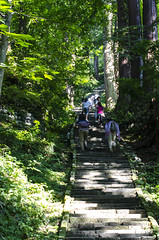
3. And while most of those flights are near-vertical, if you take your time, I can see how the cedar lined walkways could be quite the romantic experience, as the sunlight stippled stones wind their way over calm streams and around thousand year-old, moss-covered shrines and pagodas. However, dripping with sweat and being beaten up the course by three, spritely junior high girls, I found it to be soul-crushing and humbling.
At the end of the stairs is an active, well-kept shrine in the modern style, as you would come to expect from your tours of Japan. While the shrine itself is not particularly the image of divine contemplation, I suppose it is supposed to be the experience of getting to the shrine that is sublime.
Actually, we spent most of our time, while not gassed and embarrassed by 80 year-old grandmas with walking sticks, looking for the 33 ancient carvings in the stone walk way. It is said that if you find all 33 icons, your dreams will come true. But between age and random tagging in the stone facing, at best we found only 15 or so. But, in the fine tradition of ascetic monks everywhere, I figure that there are probably really only 15 or so etchings; a Magritte-esque slight-of-hand to suggest that if our vision is so narrowed by our selfish desires, we miss the transcendence of the journey. Or something like that.
Ostensibly, from Haguro, one makes the eight hour hike to Yudono, a power-spot famous as being the artesian root of the hot springs of Tsuruoka. Here, in AD605, it is said that Hachiko was inhabited by the Buddha and given the revelation that the Shinto gods were all avatars of the Buddha himself.
And, thusly, Yudono, though not the highest of the three shrines, is considered to be the most important to the Shingon Sect. So sacred is the shrine, in fact, that pictures are strictly forbidden beginning all the way from the 大鳥居 gate at the welcome center, 2km away.
After a short walk along a ravine wall and across a narrow, wooden bridge, you find yourself at a Shinto-styled station waylaid by a brown and red stone face that overlooks lush, green folds of pines below. There, at the gate, you must remove your shoes and complete the remaining five minute walk barefoot over stones, but only after a short purification ritual (nominal fee: ¥$5
4Of course a small price to pay for your soul
4). As sacred as the site itself is, the priests there say that your experience at the shrine is just as sacred and so should never be spoken of or even listened to.Suffice it to say, then, though the shrine at Yudono took no more than an hour to see, it was truly a unique experience, especially to merely be witness to any Shinto ceremony, which tend to be rather exclusive in its familial intimacy (and cost)5. Of course, admittedly, at the end of the eight hour hike to and from Gassan, the one hour at Yudono could theoretically feel like a spiritual eternity.
But I’ll leave that to you asceticists. I have a bus to catch.
Monday, September 16, 2013
For What It's Worth
A couple weeks ago Kashew and I realized that we had an extended weekend coming up. In September, we have a couple of Mondays and Tuesdays off, but these are no ordinary holidays. Rather, they are mid-week CTO for Saturday in-service for Junior High Open House and Bunkasai, which meant that, if we felt so inclined, we could prepare a trip almost anywhere in Japan and expect tourist crowds to be at a minimum.
For a long while we’ve been eyeing a trip to Yakushima (屋久島、鹿児島県、九州), the UNESCO nature preserve off the coast of Kagoshima that is home to some of the oldest trees in the world, as well as the inspiration for the setting of much of Mononoke Hime, only the best movie Japan has ever produced.
In August, we found some really cheap ticket prices
But I just wasn’t sure. By our estimation, we would fly into Kagoshima late in the weekend and catch the 4-hour ferry (or 3-hour foil) out to Yakushima. Theoretically, if we were to get back to Kagoshima in time to see anything in Kyushu before catching our flight back to Kanto, we’d most likely spend a mere two half-days on the island itself.
Admittedly, after perusing the suspiciously short list of things there are to do in Yakushima, two half-days would seem like an appropriate amount of time to see a good majority of the things there are to see there. Except that of the four things to do listed on the Japan-Guide.com website, only one of them did not use the words “multi-hour” and “hike” in any sort of combination.
This created a dilemma.
Would it be worth it to spend the hundreds and hundreds of dollars and half-dozen hours it would cost to fly down to Kagoshima and catch the ferry to Yakushima only to really be able to say, ‘Yeah, I’ve been there,’ but not be able to say, ‘Yeah, I’ve seen that’?
"Cost" is an interesting variable, and one whose aspects have changed for me over time. Having grown up in a somewhat affluent area of Southern California, there have only been two distinct periods in my life where public transportation has played an important role in my every day traveling.
Back in 2005 or so, I used the extensive network of Boston Public Transportation to my full advantage, running from one end of Downtown to the other and, back and forth across the Charles by ferry or bus or rail on a daily basis.
At that time, what mattered most to me was not particularly the financial cost: what mattered most to me was time, which combination of transportation modes would get me from point-A to point-B in the least amount of time, regardless of back-tracking or line-skirting.
Whether there was any actual reason to be in a hurry was inconsequential. The mere shaving of minutes off of regular travel routes was its own point of pride.
And now whether it is that I have just grown somnolent in the last 9 years, but all of that rushing now seems so senseless and particularly pointless to me. My metric of value has shifted: no longer do those 3 minutes “saved” mean much of anything, especially if it’s a matter of spending 3 minutes in the train or 3 minutes standing on the platform waiting for the next train. What matters most in how I plan my travel itineraries now is “total number of transfers”: the total number of times I have to stand up, walk up the stairs and across the pedestrian overpass, and board another car, hoping to find an open seat.
If time is money, I have decided to cash in on comfort.
The 常磐線, the train route that services the greater Kashiwa area, has two lines, the Rapid and the Local. The Rapid stops at 8 stations between Toride and Ueno, skipping minor stations like Kita-Kashiwa, where I happen to live.
And while the Joban Rapid gets from Ueno to Kashiwa 20 minutes faster than the local, because I would need to transfer from the Rapid to the Local at Kashiwa to get to Kita-Kashiwa, it always gives me pause
This brought about the discussion of ‘worth.’ What does it mean that it would be ‘worth’ doing something?
The negative way of thinking in this situation seemed to be along the lines of opportunity: “When will you ever again have the opportunity to go,” especially if this is my last year working in Japan. As an opportunist, it may be surprising to think that this approach could be classified as negative. But, ultimately, the question is asking, “How will you know if you will ever be able to have this chance again?” which, to me, is a negative way of looking at opportunities of agency. The counter question is, “Why do you assume that I would not be able to go if I no longer lived in Kashiwa?”
The true opportunity is one of convenience, not of availability. And while every opportunity must be weighed against its cost, opportunities of convenience must be weighed against future cost + potential inconvenience.
Presently, the convenience offered is exclusivity (being a small minority on holiday at the time) and assured proximity (traveling from Kanto to Kyushu is much closer than traveling from LA to Kyushu, though next year I may very well find myself in Kansai, which would be a decrease in potential inconvenience).
The necessarily incurred inconveniences by taking advantage of this opportunity are our time limitations and travel fees plus incidental costs, such as the fact that my MacBook Pro just died and will have to be replaced at great expense within the end of the year.
At this point, the variables have become confused. This begs me to clearly articulate my analytic metrics: the one we will use in this instance is cost versus potential enjoyment against the cost of deferment.
This geometric theory can be summed up by asking, “Will I enjoy[Ʃ]: X(activity) for Y(amount of time) at Z(cost) more than [Replacement Activity]?” It’s the VORP of travel planning.
In the Yakushima Intiative, it appears that the sole variable in question is that of Y: time. The amount of time we have allotted would likely diminish the amount of potential Ʃnjoyment of said experience. Or would it?
Could anybody guarantee the greater amount of fun Yakushima would be if I had 2, 3 or even 4 whole days on the island? Or, incidentally, could that risk be mitigated by increasing the amount of time we could spend hanging out in and around Kagoshima before or after?
Presently, I would be inclined to say that at the current expected cost, such an improved outcome would be likely with more time to relax. So it would seem that deferring the trip would be preferable, despite the potentially great possibility that no opportunity to go would arise the longer I wait
However, even if Yakushima scores lowly with the present metric (Event[Experience; Opportunity; Company; &tc.] :: Cost[Time; Money; Energy; &tc.]), within the immediate context, is there anything better I would be doing with my time than going? Finally get around to touring 青森県? Maybe even 福島県? Four consecutive days of 焼き肉食放題? Four consecutive days of 柔道? Four consecutive days of sitting at home alone and watching TV?
Despite having an overall lower ceiling, all of these other activities also happen to have much lower costs and, therefore, much higher likelihood of satisfaction associated with it. Thusly, not going to Yakushima seems to have a greater likelihood of resulting in Ʃnjoyment.
However, this is only so if I actually make other plans.
For a long while we’ve been eyeing a trip to Yakushima (屋久島、鹿児島県、九州), the UNESCO nature preserve off the coast of Kagoshima that is home to some of the oldest trees in the world, as well as the inspiration for the setting of much of Mononoke Hime, only the best movie Japan has ever produced.
In August, we found some really cheap ticket prices
1The influx of LCCs in Japan have really opened up domestic travel at around \$130 round trip.
1 and were getting set to drop some dough and go for a four-day retreat and 温泉.But I just wasn’t sure. By our estimation, we would fly into Kagoshima late in the weekend and catch the 4-hour ferry (or 3-hour foil) out to Yakushima. Theoretically, if we were to get back to Kagoshima in time to see anything in Kyushu before catching our flight back to Kanto, we’d most likely spend a mere two half-days on the island itself.
Admittedly, after perusing the suspiciously short list of things there are to do in Yakushima, two half-days would seem like an appropriate amount of time to see a good majority of the things there are to see there. Except that of the four things to do listed on the Japan-Guide.com website, only one of them did not use the words “multi-hour” and “hike” in any sort of combination.
This created a dilemma.
Would it be worth it to spend the hundreds and hundreds of dollars and half-dozen hours it would cost to fly down to Kagoshima and catch the ferry to Yakushima only to really be able to say, ‘Yeah, I’ve been there,’ but not be able to say, ‘Yeah, I’ve seen that’?
"Cost" is an interesting variable, and one whose aspects have changed for me over time. Having grown up in a somewhat affluent area of Southern California, there have only been two distinct periods in my life where public transportation has played an important role in my every day traveling.
Back in 2005 or so, I used the extensive network of Boston Public Transportation to my full advantage, running from one end of Downtown to the other and, back and forth across the Charles by ferry or bus or rail on a daily basis.
At that time, what mattered most to me was not particularly the financial cost: what mattered most to me was time, which combination of transportation modes would get me from point-A to point-B in the least amount of time, regardless of back-tracking or line-skirting.
Whether there was any actual reason to be in a hurry was inconsequential. The mere shaving of minutes off of regular travel routes was its own point of pride.
And now whether it is that I have just grown somnolent in the last 9 years, but all of that rushing now seems so senseless and particularly pointless to me. My metric of value has shifted: no longer do those 3 minutes “saved” mean much of anything, especially if it’s a matter of spending 3 minutes in the train or 3 minutes standing on the platform waiting for the next train. What matters most in how I plan my travel itineraries now is “total number of transfers”: the total number of times I have to stand up, walk up the stairs and across the pedestrian overpass, and board another car, hoping to find an open seat.
If time is money, I have decided to cash in on comfort.
The 常磐線, the train route that services the greater Kashiwa area, has two lines, the Rapid and the Local. The Rapid stops at 8 stations between Toride and Ueno, skipping minor stations like Kita-Kashiwa, where I happen to live.
And while the Joban Rapid gets from Ueno to Kashiwa 20 minutes faster than the local, because I would need to transfer from the Rapid to the Local at Kashiwa to get to Kita-Kashiwa, it always gives me pause
This brought about the discussion of ‘worth.’ What does it mean that it would be ‘worth’ doing something?
The negative way of thinking in this situation seemed to be along the lines of opportunity: “When will you ever again have the opportunity to go,” especially if this is my last year working in Japan. As an opportunist, it may be surprising to think that this approach could be classified as negative. But, ultimately, the question is asking, “How will you know if you will ever be able to have this chance again?” which, to me, is a negative way of looking at opportunities of agency. The counter question is, “Why do you assume that I would not be able to go if I no longer lived in Kashiwa?”
The true opportunity is one of convenience, not of availability. And while every opportunity must be weighed against its cost, opportunities of convenience must be weighed against future cost + potential inconvenience.
Presently, the convenience offered is exclusivity (being a small minority on holiday at the time) and assured proximity (traveling from Kanto to Kyushu is much closer than traveling from LA to Kyushu, though next year I may very well find myself in Kansai, which would be a decrease in potential inconvenience).
The necessarily incurred inconveniences by taking advantage of this opportunity are our time limitations and travel fees plus incidental costs, such as the fact that my MacBook Pro just died and will have to be replaced at great expense within the end of the year.
At this point, the variables have become confused. This begs me to clearly articulate my analytic metrics: the one we will use in this instance is cost versus potential enjoyment against the cost of deferment.
This geometric theory can be summed up by asking, “Will I enjoy[Ʃ]: X(activity) for Y(amount of time) at Z(cost) more than [Replacement Activity]?” It’s the VORP of travel planning.
In the Yakushima Intiative, it appears that the sole variable in question is that of Y: time. The amount of time we have allotted would likely diminish the amount of potential Ʃnjoyment of said experience. Or would it?
Could anybody guarantee the greater amount of fun Yakushima would be if I had 2, 3 or even 4 whole days on the island? Or, incidentally, could that risk be mitigated by increasing the amount of time we could spend hanging out in and around Kagoshima before or after?
Presently, I would be inclined to say that at the current expected cost, such an improved outcome would be likely with more time to relax. So it would seem that deferring the trip would be preferable, despite the potentially great possibility that no opportunity to go would arise the longer I wait
2Though as an actionable situation, the variable of Will will ostensibly tilt the equation. One of my Statistics pet-peeves is the tendency to treat actionable situations as if they were random occurrences, and therefore suggest that statistics are predictive rather than indicative.
2.However, even if Yakushima scores lowly with the present metric (Event[Experience; Opportunity; Company; &tc.] :: Cost[Time; Money; Energy; &tc.]), within the immediate context, is there anything better I would be doing with my time than going? Finally get around to touring 青森県? Maybe even 福島県? Four consecutive days of 焼き肉食放題? Four consecutive days of 柔道? Four consecutive days of sitting at home alone and watching TV?
Despite having an overall lower ceiling, all of these other activities also happen to have much lower costs and, therefore, much higher likelihood of satisfaction associated with it. Thusly, not going to Yakushima seems to have a greater likelihood of resulting in Ʃnjoyment.
However, this is only so if I actually make other plans.
Subscribe to:
Posts (Atom)