Friday, September 27, 2013

The Path of 10,000 Stones

When I got to Boston, I found myself enrolled in EN844: Medieval Mystics.

Now, this was hardly my first Medieval Literature course. In fact, I have had a long, tantric love affair with Medieval Literature that included a self-hating course
1Me, not the course.
1 in Beowulf, in its original Old English.

And so in reading the texts of the Medieval Christian Mystics, that these people would struggle to come to grips with their humanity was not so surprising. What was amazing was the lengths they would go to apply the critical theory they espoused in an attempt to transublimate the divine they found inaccessible in everyday life.

These people would veritably tear up the floor boards of their being to examine the bits and pieces of their soul. Their austere lives took, piecemeal, their psyches, removing it from its whole to scrub its parts until it lustered, getting to know every nook and cog, coming to know, intimately, the function of its pieces and begin to see the potential in the machine. The processes of prolonged fasting and physical and emotional self-flagellation laid bare the shape of their souls in the hopes to purify their vessel adequately to become a receptacle for the divine.

This is hardly a phenomenon unique to the West. Nearly every moderately developed religion produces sects of ascetic practitioners whose bodies of work leave indelible marks on the landscape of belief.

2013-09-23_Yamagata016

In the late 6th century, Prince Hachiko (蜂子皇子), the son of Emperor Sushuo (崇峻天皇), began a religious journey of self- (and political-) rediscovery as he fled the Soga clan (蘇我氏) from his home in the capital of Kyoto.

Having made the 700km journey from the opulent, steamy West of Geishas and tea houses to the austere, frozen, barbarian lands of Tsuruoka in Yamagata (鶴岡市、山形県), his diligence was rewarded with a vision from a three-legged cow, who came as a messenger from the gods: climb Mount Haguro (羽黒山), and there, purify yourself and you will find the enlightenment which you seek.

At the top of Mount Haguro, as one deposed and in exile, he would dedicate his life to rigorous ascetic pursuits and later establish a shrine, Dewa Sanzan (出羽三山), and two more subsequent shrines at the nearby summits of Yudono (湯殿山) and Gassan (月山), where he would achieve the climax of his religious experience.

The Dewa Sanzan (both individually and as a unit) persists as a testament to ascetic religious experience. Even today one can make the arduous three day pilgrimage (お遍) to the three sacred power-spots (霊山) in classic ascetic fashion, wearing straw sandals and the 浄衣 of the Shinto religious class. But if you’re not so hardy, as I tend not to be, one can take any number of buses to the summits of any three of the mountains, though it will cost you a hefty fee
2Public transportation: an ascetic practice all on its own.
2. From Tsuruoka (鶴岡) Station, each bus takes about two hours to its destination, but just the bus to the Yudono Information Center alone cost us ¥$18 each (one way).

These buses run limited service in non-peak season, meaning that they run fewer than once every hour (mid-day we had to wait four-and-a-half hours for a return trip from Yudono), but it would seem that even that could be considered part of the ascetic journey, if you were trying to be optimistic. That being said, if you’re going to go to Tsuruoka, book a tour: it seemed much more convenient and expedient.

Kashew and I only had time (and energy) to visit the lower two of the shrines, Haguro and Yudono.

They say that Haguro is the most easily accessible of the three to visit, as there is literally a bus stop at the shrine-summit. But what kind of experience is that?

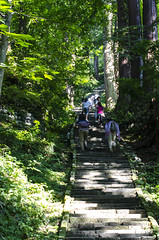
The alternative is to get off the bus at the Welcome Center and take the leisurely stroll up the 2,446 steps to the shrine
3
2013-09-23_Yamagata015
3. And while most of those flights are near-vertical, if you take your time, I can see how the cedar lined walkways could be quite the romantic experience, as the sunlight stippled stones wind their way over calm streams and around thousand year-old, moss-covered shrines and pagodas.

However, dripping with sweat and being beaten up the course by three, spritely junior high girls, I found it to be soul-crushing and humbling.

At the end of the stairs is an active, well-kept shrine in the modern style, as you would come to expect from your tours of Japan. While the shrine itself is not particularly the image of divine contemplation, I suppose it is supposed to be the experience of getting to the shrine that is sublime.

Actually, we spent most of our time, while not gassed and embarrassed by 80 year-old grandmas with walking sticks, looking for the 33 ancient carvings in the stone walk way. It is said that if you find all 33 icons, your dreams will come true. But between age and random tagging in the stone facing, at best we found only 15 or so. But, in the fine tradition of ascetic monks everywhere, I figure that there are probably really only 15 or so etchings; a Magritte-esque slight-of-hand to suggest that if our vision is so narrowed by our selfish desires, we miss the transcendence of the journey. Or something like that.

Ostensibly, from Haguro, one makes the eight hour hike to Yudono, a power-spot famous as being the artesian root of the hot springs of Tsuruoka. Here, in AD605, it is said that Hachiko was inhabited by the Buddha and given the revelation that the Shinto gods were all avatars of the Buddha himself.

And, thusly, Yudono, though not the highest of the three shrines, is considered to be the most important to the Shingon Sect. So sacred is the shrine, in fact, that pictures are strictly forbidden beginning all the way from the 大鳥居 gate at the welcome center, 2km away.

After a short walk along a ravine wall and across a narrow, wooden bridge, you find yourself at a Shinto-styled station waylaid by a brown and red stone face that overlooks lush, green folds of pines below. There, at the gate, you must remove your shoes and complete the remaining five minute walk barefoot over stones, but only after a short purification ritual (nominal fee: ¥$5
4Of course a small price to pay for your soul
4). As sacred as the site itself is, the priests there say that your experience at the shrine is just as sacred and so should never be spoken of or even listened to.

Suffice it to say, then, though the shrine at Yudono took no more than an hour to see, it was truly a unique experience, especially to merely be witness to any Shinto ceremony, which tend to be rather exclusive in its familial intimacy (and cost)5. Of course, admittedly, at the end of the eight hour hike to and from Gassan, the one hour at Yudono could theoretically feel like a spiritual eternity.

But I’ll leave that to you asceticists. I have a bus to catch.

Monday, September 16, 2013

For What It's Worth

A couple weeks ago Kashew and I realized that we had an extended weekend coming up. In September, we have a couple of Mondays and Tuesdays off, but these are no ordinary holidays. Rather, they are mid-week CTO for Saturday in-service for Junior High Open House and Bunkasai, which meant that, if we felt so inclined, we could prepare a trip almost anywhere in Japan and expect tourist crowds to be at a minimum.

For a long while we’ve been eyeing a trip to Yakushima (屋久島、鹿児島県、九州), the UNESCO nature preserve off the coast of Kagoshima that is home to some of the oldest trees in the world, as well as the inspiration for the setting of much of Mononoke Hime, only the best movie Japan has ever produced.

In August, we found some really cheap ticket prices
1The influx of LCCs in Japan have really opened up domestic travel at around \$130 round trip.
1 and were getting set to drop some dough and go for a four-day retreat and 温泉.

But I just wasn’t sure. By our estimation, we would fly into Kagoshima late in the weekend and catch the 4-hour ferry (or 3-hour foil) out to Yakushima. Theoretically, if we were to get back to Kagoshima in time to see anything in Kyushu before catching our flight back to Kanto, we’d most likely spend a mere two half-days on the island itself.

Admittedly, after perusing the suspiciously short list of things there are to do in Yakushima, two half-days would seem like an appropriate amount of time to see a good majority of the things there are to see there. Except that of the four things to do listed on the Japan-Guide.com website, only one of them did not use the words “multi-hour” and “hike” in any sort of combination.

This created a dilemma.

Would it be worth it to spend the hundreds and hundreds of dollars and half-dozen hours it would cost to fly down to Kagoshima and catch the ferry to Yakushima only to really be able to say, ‘Yeah, I’ve been there,’ but not be able to say, ‘Yeah, I’ve seen that’?


"Cost" is an interesting variable, and one whose aspects have changed for me over time. Having grown up in a somewhat affluent area of Southern California, there have only been two distinct periods in my life where public transportation has played an important role in my every day traveling.

Back in 2005 or so, I used the extensive network of Boston Public Transportation to my full advantage, running from one end of Downtown to the other and, back and forth across the Charles by ferry or bus or rail on a daily basis.

At that time, what mattered most to me was not particularly the financial cost: what mattered most to me was time, which combination of transportation modes would get me from point-A to point-B in the least amount of time, regardless of back-tracking or line-skirting.

Whether there was any actual reason to be in a hurry was inconsequential. The mere shaving of minutes off of regular travel routes was its own point of pride.

And now whether it is that I have just grown somnolent in the last 9 years, but all of that rushing now seems so senseless and particularly pointless to me. My metric of value has shifted: no longer do those 3 minutes “saved” mean much of anything, especially if it’s a matter of spending 3 minutes in the train or 3 minutes standing on the platform waiting for the next train. What matters most in how I plan my travel itineraries now is “total number of transfers”: the total number of times I have to stand up, walk up the stairs and across the pedestrian overpass, and board another car, hoping to find an open seat.

If time is money, I have decided to cash in on comfort.

The 常磐線, the train route that services the greater Kashiwa area, has two lines, the Rapid and the Local. The Rapid stops at 8 stations between Toride and Ueno, skipping minor stations like Kita-Kashiwa, where I happen to live.

And while the Joban Rapid gets from Ueno to Kashiwa 20 minutes faster than the local, because I would need to transfer from the Rapid to the Local at Kashiwa to get to Kita-Kashiwa, it always gives me pause


This brought about the discussion of ‘worth.’ What does it mean that it would be ‘worth’ doing something?

The negative way of thinking in this situation seemed to be along the lines of opportunity: “When will you ever again have the opportunity to go,” especially if this is my last year working in Japan. As an opportunist, it may be surprising to think that this approach could be classified as negative. But, ultimately, the question is asking, “How will you know if you will ever be able to have this chance again?” which, to me, is a negative way of looking at opportunities of agency. The counter question is, “Why do you assume that I would not be able to go if I no longer lived in Kashiwa?”

The true opportunity is one of convenience, not of availability. And while every opportunity must be weighed against its cost, opportunities of convenience must be weighed against future cost + potential inconvenience.

Presently, the convenience offered is exclusivity (being a small minority on holiday at the time) and assured proximity (traveling from Kanto to Kyushu is much closer than traveling from LA to Kyushu, though next year I may very well find myself in Kansai, which would be a decrease in potential inconvenience).

The necessarily incurred inconveniences by taking advantage of this opportunity are our time limitations and travel fees plus incidental costs, such as the fact that my MacBook Pro just died and will have to be replaced at great expense within the end of the year.

At this point, the variables have become confused. This begs me to clearly articulate my analytic metrics: the one we will use in this instance is cost versus potential enjoyment against the cost of deferment.

This geometric theory can be summed up by asking, “Will I enjoy[Ʃ]: X(activity) for Y(amount of time) at Z(cost) more than [Replacement Activity]?” It’s the VORP of travel planning.

In the Yakushima Intiative, it appears that the sole variable in question is that of Y: time. The amount of time we have allotted would likely diminish the amount of potential Ʃnjoyment of said experience. Or would it?

Could anybody guarantee the greater amount of fun Yakushima would be if I had 2, 3 or even 4 whole days on the island? Or, incidentally, could that risk be mitigated by increasing the amount of time we could spend hanging out in and around Kagoshima before or after?

Presently, I would be inclined to say that at the current expected cost, such an improved outcome would be likely with more time to relax. So it would seem that deferring the trip would be preferable, despite the potentially great possibility that no opportunity to go would arise the longer I wait
2Though as an actionable situation, the variable of Will will ostensibly tilt the equation. One of my Statistics pet-peeves is the tendency to treat actionable situations as if they were random occurrences, and therefore suggest that statistics are predictive rather than indicative.
2.

However, even if Yakushima scores lowly with the present metric (Event[Experience; Opportunity; Company; &tc.] :: Cost[Time; Money; Energy; &tc.]), within the immediate context, is there anything better I would be doing with my time than going? Finally get around to touring 青森県? Maybe even 福島県? Four consecutive days of 焼き肉食放題? Four consecutive days of 柔道? Four consecutive days of sitting at home alone and watching TV?

Despite having an overall lower ceiling, all of these other activities also happen to have much lower costs and, therefore, much higher likelihood of satisfaction associated with it. Thusly, not going to Yakushima seems to have a greater likelihood of resulting in Ʃnjoyment.

However, this is only so if I actually make other plans.

Monday, September 9, 2013

Summer Break 2013

Hey Nick,

Short post today. I’ve been tossing some ideas around for a while but none of them seem to stick to the walls. So I made an arbitrary deadline to post something by the end of Labor Day (even though it’s getting hard to remember, exactly, which day is Labor Day). But the blog’s been a little too quiet of late. I promise a more robust article on something (*anything) soon.


Perhaps one of the only difficulties about visiting home on vacation is that you know that there is going to be a short list of five or six questions that everyone is going to ask.

“How is Japan?” “When are you moving back to America?” “Have you married anyone?”

I don’t think it’s malicious or lazy, but because these questions do seem predicated solely upon the assumptions of social normalcy, they are tiring in their presumptive inevitability, like with clearing customs, it’s a probationary check-in on my progress as a ‘normal,’ contributing member of society. Sometimes, it would seem more efficient to print up an FAQ for distribution upon arrival: “Japan is great, but hot. My contract ends in July of next year and I have no firm plans yet, though I am looking. And no, I am enjoying my free time and copious amounts of bachelor ca$he.”

I guess that it’s the same regardless of which life stage you are in. The same kinds of questions are passed around like greeting cards to recent grads, to single people past their thirties, married peoples without children, and on and on and on.

Fact is, most people are genuinely interested in hearing how things are going, and if we haven’t been in constant contact, these micro-inquisitions are probably the most accessible, expeditious ways to jump right in.

And to eschew such conversation is the same to eschew all such small talk and ignore the fact that a large amount of information is still communicated through such seemingly meaningless exchange of white noise.

Over the weekend we had the opportunity to drive up to Nipomo for a family gathering. It was a pretty big event so we managed to pack the grandparents in with the luggage and make the short three-and-a-half hour drive up the coast for a weekend away.

While we were there, we met the grandmother of my brother’s fiancée, a Japanese woman of comparable age to my grandfather, who is also Japanese American. After the introductions were made, the two of them were left together to chat.

Their conversation faltered, so my grandpa started in to his version of small-talk: “What camp were you stationed at,” he asked.

Both being Japanese American and alive during World War II, this remains a touchstone for them 70 years later. It’s not the first time that I’ve overheard him begin a conversation with this and though he, personally, has always been reticent to talk to us about his experience at the internment camps, I’ve always been curious as to what sorts of identifiers he feels he learns from asking people where they were stationed.

I suppose the same sorts of things could be said about any or all small talk—the weather, work plans, internment: we’re all just plying for conversational ins and looking for pathways of permission from points of common contact.

Tuesday, August 6, 2013

Teganuma Hanabi Taikai

Hey Nick,

I noticed that you finally evolved your Hino Kagutsuchi in Puzzle & Dragons
1That's one Puzzle, multiple Dragons. Also available for Android devices.
1. Wayne and I were wondering if you just didn't know about Ultimate Evolutions or had just not yet collected all of the pieces.

Anyway, just wanted to say that P&D is old-hat. All the cool kids are now playing Wind Runner. It's a Line-Appli game. It's fun, kinda. Or not. I don't know.


The first thing you have to know about Kita-Kashiwa
2北柏.
2 is that it is where I live. The second thing is that, apart from M&J Billiards and Darts above the 7-11, there's not that much going on in Kita-Kashiwa. For a brief while, Kita-Kashiwa was the talk of the town as rumors incessantly hummed about the Costco that was going to be built down by the Monsoon Love Hotel. The fact that Costco was seriously contemplating opening their 10th Kanto area store in a gigantic empty lot down the street from my apartment was a constant drone, like the sound of the summer cicadas. Where were they going to build the parking lot? Were they going to widen the streets or expand the station? Maybe even make it a stop along the Rapid Line? A sure mark that Kita-Kashiwa had "made it" as a major economic factor in North-Chiba.

But like most businesses, they took a look around and decided that there just wasn't enough people in the Teganuma area to warrant an investment and chose Tsukuba: that boom-town of a city. Instead, in that empty lot they built a gigantic logistics facility that I have yet seen a truck drive in or out of since the last cement truck pulled away and the tape came down six months ago. But it is a very nice building. And very well lit.

Despite the fact that there are only a handful of eateries and the nearest supermarket is a 10 minute bike ride uphill across the river, Kita-Kashiwa is a nice place to live. It's quaint. It's train-convenient. It's often quiet
3except when the ヤンキース ride through on their modded-out bikes.
3. And it's my home.

But it's also the home of the area's largest annual fireworks festival, the 手賀沼花火大会.

You'll have to forgive me for not knowing much about the hanabi-taikai, except that it is a hundreds-year-old-tradition that happens every year in thousands of places across Japan on the first Saturday of August.

And while I didn't get to go last year because it was cancelled due to the general instability of the Japanese economy, or the year before because of the Tohoku Disaster, I had no intention to go to go out of my way to see any 花火大会 this year, even though this could very well have been my only chance.

Either way, whatever my reasons were--because they're probably stupid anyway--I was not really planning on going. Maybe I'd take in a movie, or read a book, or go out on a date instead: you know, any number of statistical improbabilities. I was just going to watch TV and eat popcorn.

But I digress. Where was I? Oh yes.

I was not planning on going to watch fireworks. Years of Disney-branded Fireworks Extravaganzas have jaded me to the possibilities of any interest in civic-sponsored firework events.

So when a coworker in the Foreign Language Department asked me if I was planning on walking the 100 meters down the road to Furusato Koen (the chic place to catch some summer sizzle), I told her, "No, I wasn't planning on it."

She must have thought that I was expressing concern for the bustle of the event, since it being a community staple, it was unthinkable that anyone would choose to not to want to go.

"Oh, I see," she said. "If Kita-Kashiwa is too crowded," she continued, "you should go see Kashiwa-no-Ha's fireworks display."

"Oh," I nodded politely in response.

"But their show is a little small this year."

"Oh," I said.

"Yeah. This year it's only 45-minutes."

"Oh," I said.

This year's Teganuma Hanabi Taikai clocked in at a little over 90 minutes long, a few million mosquitoes deep, and one really creepy looking amphibious cricket-beetle thing that tried to make babies with my forearm.

I will pass no critical judgement over the fireworks show itself save for two points: 1) a 90-minute fireworks show is just what you'd think it would be, just imagine six fifteen-minute fireworks shows playing consecutively; and, 2) they actually set off fireworks on the lake's surface. That, itself, would only have been surpassed in coolness if they skipped fireworks across the lake. Which is to say, that that is still pretty cool.

Fun fact: up until 2011, Teganuma was Japan's dirtiest lake. Now it is only number 2 on the list.

Bonus flair: this summer's hot J-dance track is last summer's J-sleeper. 安室奈美恵's ONLY YOU!

Tuesday, June 25, 2013

Cultural Exchange

"So, American students," Kuwabara-先生 called out into the crowded hall, "how many of you agree with the article? How many of you like what Yu Darvish had said?"

The question was simple. So simple it was a tad mundane. And for the most part, the North High students considered the question so mundane that it hardly warranted a fully raised hand, merely a lazily lofted arm: two-dozen or so palms wisped like daisies made heavy with the morning dew.

But the surprise that bubbled from the Japanese students belied just how exceptional the question actually was.

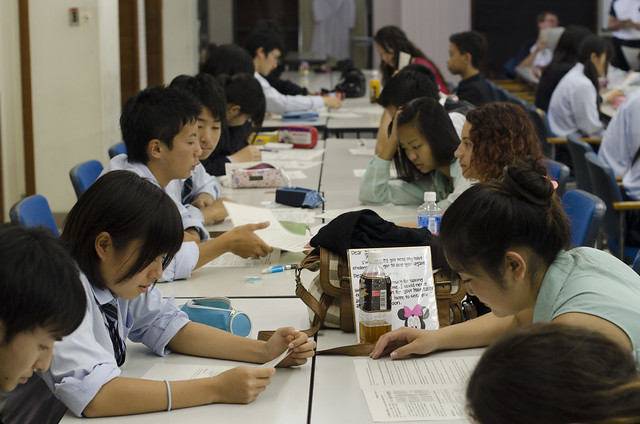
2013-05-30_3DReading013

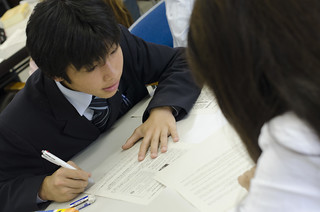
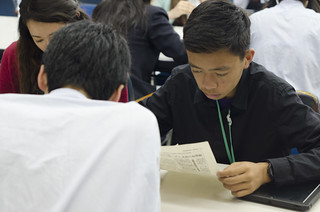
Every year, 柏市立柏高等学校 hosts a group of 20-or-so students from North Torrance High School from the South Bay area of Los Angeles, California. For a whole week, these students come and live with an Ichikashi student, even attending “regular” classes with Japanese students. However, the very nature of having non-Japanese speaking students in all-Japanese classes that balloon up to 50 or 60 people per session requires that these classes always offer specially tailored activities that pay special mind towards cross-cultural exposure and cooperation.

And, so, Kuwabara prepped his reading class a week in advance of the North High students’ arrival, leading 3-D組 in a small discussion about the most important characteristics of a Japanese person. “When you think of what makes a Japanese person different from all other people in the world,” it was asked, “what traits come to mind?”

The students came up with two answers that were basically the flip-side of each other: 1) Japanese people are “modest,” and 2) Japanese people “lack self-confidence.” These traits, it was believed, stood in direct opposition to what the American students were going to bring to the class they would share at the end of the month.

And so, on the day of 3-D組 Reading, the class was abuzz with nervous energy, the Japanese kids exuding polite deference while the Americans, no doubt, brimmed with confidence and pride. Kuwabara passed out a packet of articles and asked the students to work together to read and interview each other with some pre-written questions in summary and analysis.

The first article was from a media conference after Yu Darvish’s first spring training appearance with the Texas Rangers. The press asked him to critique his own performance, especially noting a well-struck ball that fell just short of being a homerun. In standard Japanese-fashion he answered plainly and honestly, saying that the pitch wasn’t the best and if the batter would have just gotten a little more square it would certainly have been a homerun.

It was an unremarkable comment, in the least, except that it sparked a mini-controversy. As most fans of American baseball know, regardless of the objectivity of the assessment, the pitcher is never supposed to critique the batter. This, however, confused many of the Japanese students: such a comment is not uncommon amongst Japanese players, but this article illustrated how cultural differences can easily be misconstrued as rudeness or insult. Since many of our students only encounter foreigners as tourists in Japan, it is easy for them to read the cultural ignorance of tourists as rudeness, unaware that inter-culturally this works both ways.

2013-05-30_3DReading012     2013-05-30_3DReading007

The second article was written a few months later and focused on Darvish’s All-Star projections. Arriving much heralded as a top Japanese prospect, despite having only a few starts to his credit, Darvish was in the lead according to fan-votes to make an appearance in his very first All-Star Game in his freshman season. However, when asked to comment about the potential to pitch as a rookie, Darvish, flattered, responded by saying that he felt he had not yet earned such an honor.

And while the Japanese students lauded this response with fervent nods of approval, they fully expected the American students to shun it as too passive, as silly, as weak.

So, after being asked if they approved of what Darvish had said, when hand after American-hand sprouted amongst the field of heads in agreement, a gentle wave of murmurs of disbelief spread across the room like a spring breeze. 「ビックリでした!」, the Ichikashi students muttered under their breath: “Shocking.” Perhaps they were not the only ones who could appreciate humility.

Ultimately, it was a simple lesson with simple questions that lead to a simple and relatively predictable conclusion. But, as Kuwabara posits, these are questions that apparently have not yet been asked of our students. “They don’t really think about what it means to be Japanese,” he says of the kids, many of whom live in predominantly homogenous communities and so never have occasion to consider such critical questions, even the simple ones.

But one thing that I learned in my time as a youth advisor teaching hermeneutics in America is that we should never eschew simple questions merely for the sake that they are simple. In fact, many of the biggest interpretational mistakes I see arise from skipping the simple questions because those questions appear beneath the reader’s assumptions, because “advanced” readers shouldn’t have to bother with such low-standing bramble.

Rather, the root of critical thinking is in learning which questions, no matter how simple or reductive, always need to be asked. It is those simple questions that are often the hardest to answer, and often the real reason we learn to skip them is because it is more convenient to assume their rightness than to investigate their validity. But if left untended, the briar becomes a patch: we take their rightness for granted only to find after a few steps our feet tangled and our interpretations tripped. And many of our students, Kuwabara continues, take the composition of their Japaneseness for granted.

I have started working with Kuwabara to expand this assignment into a short series of such critical thinking assignments where, by using cultural texts in English (both resources in writing and the resident Foreign Language Instructors), they will be challenged to ask questions about what they think it means to be Japanese and how their critical approaches to this question affects those around them
1May be relevant:
1.

For example, the lesson I am currently writing, using a Facebook exchange as “text,” discusses homogeny as a core principle of national identity and what that does to students who are wholly invested in the Japanese national identity but appear to fall outside of such “normalcy” (foreign-looking people who were born and raised in Japan, for one). How assumptions of identity through “seemingness” appear to easily qualify subscription, but cruelly alienates indiscriminately.


That day I believe I saw the sublime pass over one student's face like the revelation of the divine glow of the moon passing from behind a cloud as we watched stereotypes collapse with the lazy flick of the wrist of the American students who raised their hand in passive agreement.

Not two weeks ago at a 飲み会 I was talking to Narazaki-先生, a 二学生 history teacher at Ichikashi. He was saying, as educators, they live for these moments where the practical collection of knowledge passes from mere static facts into dynamic nodes of relation and reference for the pursuit of further knowledge. That the dates of this emperor's rule or the kanji for this ancient place, these things certainly must be memorized. But there are those rare moments when, for a student who has been desperately juggling disparate names and dates all year long, everything just falls into place like plastic shapes in the game Perfection. Connections are made and the world of history opens up like an unlocked cipher, where today is now seen through the lens of yesterday, and allows us see the possibilities of tomorrow in a whole new way.

He revels in those moments—they all revel in these moments—he said, and that is when teaching feels worth it.

And then, just like in Perfection, the bell sounds and the pieces are tossed into the air, only to fall to the floor in a jumble to be collected again next period.

Thursday, June 6, 2013

Your Best Friend (SJ: 6/05)

三年生 - Elective
My friend's name is [Mariko]. She is popular with the class. She looks cute and has beautiful hair. She never loses her temper. She is never late for school. She promises she won't cause you any trouble. She would be the last person to tell a lie. She is in the same class as me. She is a good flute player. She has a sound digestive system.

Tuesday, May 21, 2013

Your Manga - 2 (SJ: 5/17)

三年生 - A(2)
He visited a castle and had to poop. He said, "I have to go to the bathroom!!"

Why does he want to go to the bathroom? Because his castle was broken by a mystery man, so the bathroom was broken. He did not get to go to the bathroom. So he was suffering from poop.

When he finally goes to the bathroom, there is no toilet paper.

He said, "I'm done," and the castle had a big explosion.

The explosion blew him away. The castle was filled with a bad smell. He was killed by the bad smell.

The end.