Monday, December 8, 2014

膳部揃うて箸を取れ

100404_1450360


Some people compulsively shop for stationary and pens. Other people peruse, as they pass, shoe departments or bag displays.

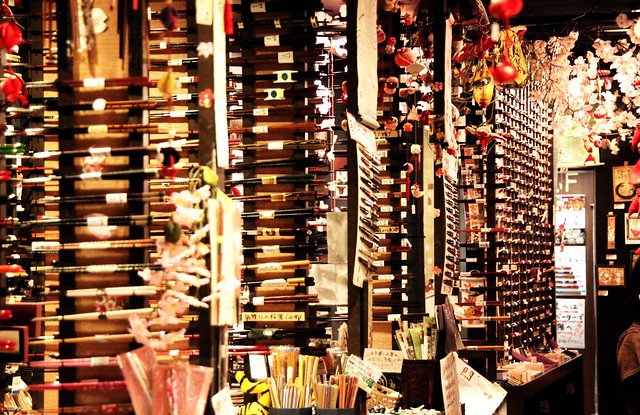
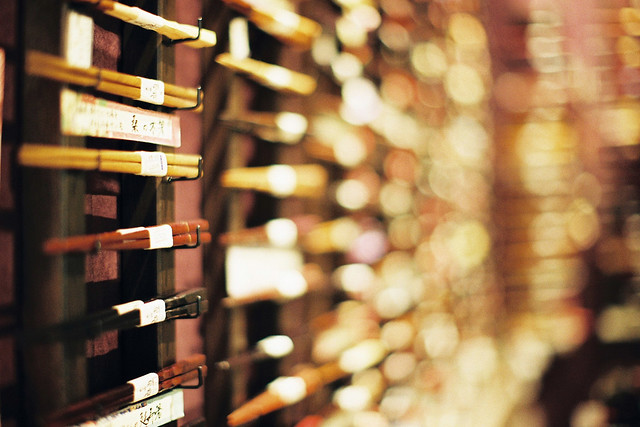
And others make it a point to find obscure, little chopstick stores and touch all of the pairs of artisan hashi (箸, はし) on display: hand-crafted of sacred woods from the deepest, oldest forests in Fukui, by artisans who have been spiral-filing by feel in Kyoto for more than four centuries.

When I saw my first 箸屋さん, I was filled with curiosity. When I saw my first pair of ¥$150 chopsticks, I was filled with incredulity.

Who would buy such a thing? And how many of those “whos” need to buy such such-a-things to maintain so many stores?

But, oh, what beautiful such-a-things they were.

Bamboo, maple, oak, composite. Round-cut, triangular, heptagonal, dodecahedral. Unmatched, interlocking fit, magnetic, lacquered, inlaid, embossed. All in patterns, shapes and designs befitting any kind of hand, any kind of personality.


It is quite common in Japan for people to have their own every-day place settings for meals. I have been to dinners where everyone has their own particular bowls, cups and plates, let alone their personal set of hashi. Even I have begun to use the same bowl and hashi out of habit.

Granted there are only two or three sets for me to choose from.

Then again, it’s not like people have houseguests over very much, so expansive matching sets of china aren’t particularly necessary. After all, where would I keep all of that extra flatware?

Dinner parties tend to be a hodgepodge of mismatched plates and bowls collected over the years
1The first pieces tend to be those that you inherit.
1, with personal pieces added through traveling or spontaneous investment.

As such, when a couple gets married, it’s not uncommon for the bride and groom to receive new place settings, including “their own hashi,” as a symbolic cornerstone of their new home together.

Until then, dinner guests use whatever’s around. And that is most often 割り箸.

In the decades following the the breaking of the Sakoku (鎖国) by the West, Japan’s economy found itself under the dark shadow of the sails of Commodore Perry’s Black Ships. Disgruntled as opportunities at home stifled and sputtered under treaties signed with force of coercion and duress, by the middle of the 19th century, Japan began preparing to go to war in the hopes that they too may benefit from the Imperial Spirit of the age, seeking to find fortune and respect abroad, in an attempt to re-exert their own will over their economic future.

A major part of any war effort requires the redistribution and rationing of resources, especially light woods that would be used in the construction of ships and airplanes. This greatly depressed many domestic markets, including chopstick manufacturing, sweeping away base-supplies in support of the war.

As access to natural woods dried up, the Meiji-led government began encouraging manufacturers look towards re-appropriating discarded furniture, wood that could easily and cheaply be ground down and pressed into things like hashi that would remain constituted long enough for at least one meal and then could just as easily be discarded.

And, thusly, the disposable chopstick industry was born.


In 2011, Rachel Nuwer of The New York Times reported that in order to access the 3.8 million trees needed to supply the annual demand for the 57 billion pairs of disposable chopsticks, China would seek to unsustainably deforest 10,800 square miles of forest. A year.

That’s 6,912,000 acres.

To put that into context, Disneyland Park in Anaheim comes in at a whopping 85 acres. The whole of Disneyland Resort is reportedly 500 acres. Of that, the seemingly massive Mickey and Friends Parking Lot is a mere 100-acres of stacked space. Disney World and its 36 on-site hotels, four theme parks, two water parks, four golf courses, camping resort and residential area, comes in at only 30,080 acres.

In fact, all 6 resorts combined
2Which would include the soon-to-be-opened-in-2016 Shanghai Disney Resort
2 logs in at a massive 36,918 acres.

It would take a space equivalent of 230 Disney Worlds a year to grow enough trees to produce the 57 billion pairs of chopsticks needed in 2011.

Of those 57 billion pairs of chopsticks, around a half are used domestically in China, while the remaining half are distributed to Japan, South Korea and the United States.

Unsurprisingly, Japan receives a majority of the remainder, at 77% of that 50% (making for 38.5%). Or using the numbers Nuwer offered previously, Japan consumes 22 billion pairs of China’s disposable chopsticks
3Called waribashi (割り箸, わりばし) in Japan.
3, making them accountable for almost 1.5 million of those trees in China. A year.

Of course, that was back in 2011.

In Jiro Taylor, using a bit of magic and an incredible list of un-cited sources, claims that with 24 billion pairs of waribashi washing ashore, Japan’s annual consumption of disposable chopsticks has reached 185-pairs per person.

And while I have no stats to back that up, I can confess that this number may be about half of my own annual usage.

None of which has or ever will be recycled.
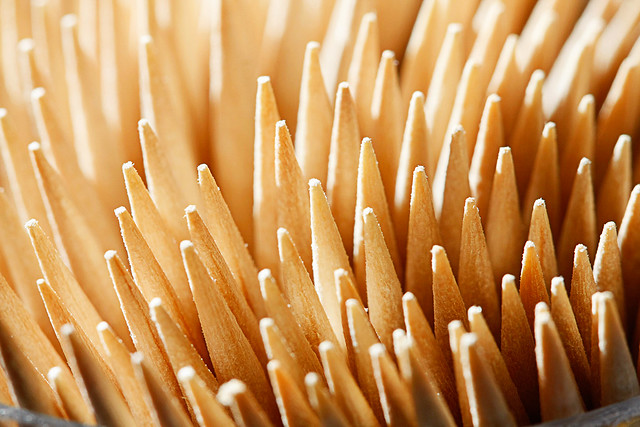
chopsticks


Unlike the absurdity that is plastic packing (re-packing and re-re-packing) in Japan, there is no “hashi-friendly” trash bag for disposable chopsticks. Soiled is the common term for used chopsticks. And, as with all soiled potentially-recyclable materials, after one use, it goes into the 燃えるゴミ bin without nary a concern.

And while convenience stores have begun asking 「箸をお使いになりますか?」mere picoseconds before dumping a handful of disposables into your bag out of habit, there is hardly a circumstance where someone says “no."

The recommended supply-side solution is the purchase of what have come to be called “マイ箸” (“My Hashi”): sturdy, no-nonsense, reusable chopsticks that you carry around with you.

I have a pair that find their home in the desk-drawer in my office. And while they certainly get used in place of waribashi for the days I happen to eat lunch at my desk, I never whip them out at restaurants. Or, really, otherwise.


Occasionally, I still find myself in a Hashi-Gallery when I’m out and about
4Unlike 手拭い (てぬぐい, tenugui), I have yet to plan trips specifically around hashi-shopping. Yet.
4. Actually, there are still one or two hashi places I take guests to when we happen upon 表参道 or 谷中銀座. I like to imagine that these storefronts are looking glasses, bridges to the ancient Floating Worlds of Edo and Kyoto.

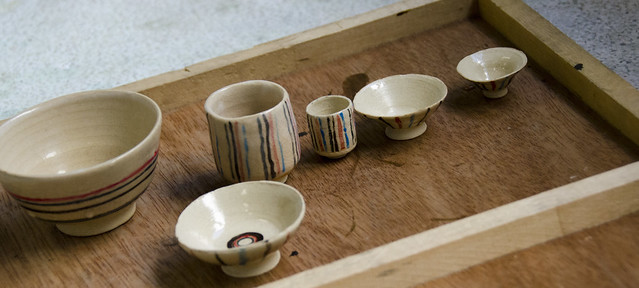
That and who doesn’t secretly want their own personal pair of hand-crafted chopsticks, selected from the rack only after deep reflection with no less solemnity than could be afforded of a wizarding wand. Of the hundreds there, to find a hashi that speaks to you; linking you to places both mystical and temporal, costly and ever-present.

Who doesn’t want that?

Thursday, September 18, 2014

The Magical Insect-Catching Pig

photo 1

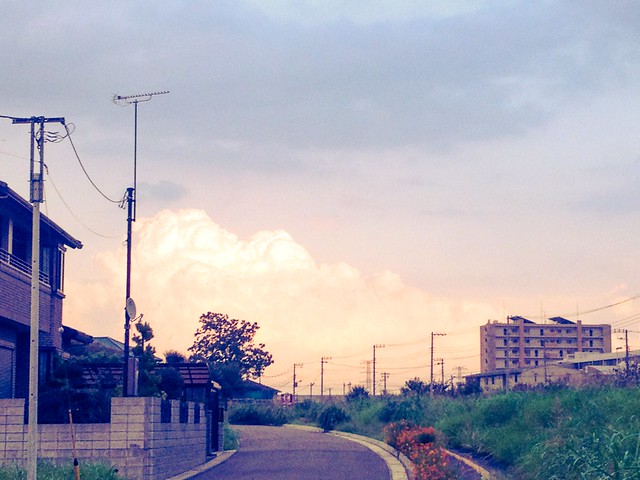
Clouds roil in the
Distance; Perhaps o'er there they
Reign for now not here.


If you ask any Japanese person to imagine themselves in a casually conceived summer landscape, you would find yourself with a fairly long list of staples, from glass 風鈴 (ふうりん, wind chimes) to sparkly 花火 (はなび, hanabi), and snowy かき氷 (かきごおり, shaved ice) to, apparently, curry. Especially if it's done while wearing a 浴衣 (ゆかた, yukata).

If you ask me to conjure an image of a Japanese summer, you'd get a man drowning in his own sweat, being eaten alive by millions and millions of tiger-mosquitos.

Whose is a more accurate representation of the true spirit of a Japanese summer, maybe no one will ever really know.

Except that I do know that the domestic (non-industrial) pesticide market in Japan (蚊遣器) is a 4.23 BILL¥$s-a-year industry
1This should be read as "Bill-yen-dollars-a-year," not "Billys's."
1. That's BILL¥$s with a capital-BILL. If this number seems outrageously high, it's probably because I made it up. I don't know the right kanji to use to search for the real numbers on Google. Or Yahoo!. Or whatever terrible search engine the Japanese people use nowadays. Maybe AltaVista.

Regardless, insecticides like 蚊取り線香 (かとりせんこう, katori-senkou) have been a Japanese summer-time tradition for millennia. As long as the Japanese have been burning incense, living things have inhaled said incense and died. And, so no image of summer in Japan would be complete if lacking the distinct paste-green (or cork-brown) coiled incense, wafting its fine, filament fingers through the moisture-laden air.

Not letting petty facts or statistics get in the way of a half-decent narrative, I think we'd all agree to include katori-senkou in our summer-collages. Whether it's the first or last thing we add is inconsequential: all that matters is that it's there. And it's almost always pictured hung, suspended in the body of a plain, ceramic housing molded to the shape of a stout, cartoon piglet: the蚊遣り豚 (かとりぶた, katori-buta), the mosquito-catching pig.

But why a ceramic pig? How is that any more "summer" or "insect-repelling" than, say, a cat, or a dog, or a tanuki, or Tommy Lee Jones?

Well, ask a simple question to a Japanese person and you get a simple Japanese answer: 「あぁ、そうなんだ。知らない。」

Yappari, "I don't know."

It has been written that Japan exists on many planes, the most important of which is the Floating World, the ephemeral world of art and inspiration, which has no ties to the messy discord of earth and yet from which man can neither ascend to heaven, but floats here and there and then disappears as the clouds go.

But, perhaps, Japan is more, as it is said in 風立ちぬ (The Wind Rises), Japan is the embodiment of Thomas Mann's Magic Mountain, "A place of forgetting." It is a wonderful world where, when you climb, the terrible past is left behind and forgotten. At the summit is fantastic play and creation and new life, unfettered, unburdened by, unbound to the world below. But to descend is to waken from the dream, a dream that is at once immaterial, inconsequential and just as soon, itself, forgotten. "Start a war in China, forget about it; start a puppet state in Manchuria, forget about it," it is said and then forgotten. And all that is remembered is how めんどくさい all that once was.

Maybe it's because pigs are immune to mosquitos, by lore, or maybe it's because they possess a great affinity for bugs and, in order for the incense to do its work, the mosquitos have to fly close to the senkou smoke. Then again, if it's like everything else in Japan, it's probably just a thing that happened to look like something and so it became a thing.

But in order to know what that "first thing" was, we had to go all the way to 三重県四日市市 (Yokkaichi City, Mie Prefecture).

Mie-Ken is in a part of Japan that is famous for producing high quality rice (and, by extension, sake)
2 But really, what place in Japan would claim otherwise?
2. And while Yokkaichi is not particularly known for any of its distilleries, it garnered great renown in the 19th century for the production of 蛮古焼 (ばんこやき, banko-yaki), a reliable, sturdy porcelain that could be used for tea ceremony implements or serve-ware and bottles for high-quality sake.

Or, if left unfinished so the bottom of the bottle remains open, and then laid on its side, becomes an excellent, aerated receptacle for a suspended katori-senko. Add some feet to stabilize the bottle or a couple eyelet flags for hanging and you have yourself a handy little...

4You don't even have to go to Mie Prefecture to see this, as this very katori-buta makes its home at the Shinjuku Historical Museum in Tokyo. Heck, I didn't even get THAT far…
4

...pig. Or what have you. What matters is that they all eventually become pigs. Even mine. And it's not even ceramic. Nor does it even use incense. But it's a pig, nonetheless. Even though it plugs into the wall.


photo 2

O'er old roads new are
Laid and forgot but thought as
Only troublesome.

Tuesday, May 27, 2014

何の日の名残り (What Remains of the Day)

A few weeks ago I was back in town visiting the family. Over my two-day stay I made it a point to do them the favor of going through some of the baker's-dozen large boxes
1To be fair, Home Depot claims that the boxes are mostly “Medium” in size.
1 of stored goods I had packed away into a number of closets as a part of my preparation to move to Japan three years ago.

The process was simple: open a box, dump out its content, and then throw everything away. After all, the thinking was that if I hadn't missed it in boxes over the past three years, I probably wasn't going to miss it in the trash.

I will admit to not touching a single one of my dozen boxes of books in the attic, but the rest I was able to consolidate into one box of ratty t-shirts, picture files, documents and portfolios, and a random assortment of gift toys that I feel more bad about throwing away than I feel compelled by romantic notions to keep.

Similarly, I will also admit that I haven't been having much trouble with sentimentality in cleaning out the apartment in Japan, either. Then again, many of my friends would argue that I have never had much trouble with sentimentality in the first place.

2014-05-14_Title001


我々は星の間に客に来て  §  "We have come to be guests among the stars."

The image is one of contrast between the hospitality of the distant, halting beauty that nature offers capitulated against the unstated tenuousness of our being. Relative to the comparatively permanent backdrop of the heavens, ours is the trembling, stolen privilege one feels entering into a great house of smoky, oaken walls, or walking down the grand chambers of a cathedral bathed in the flowing colors of stained glass.

This at-once sense of awe and terror is encapsulated in the saying, "Memento Mori": though countless trophies may rest glowingly upon your wall and mantel, always "remember that you will die." In the West, this Latinate truism echoed throughout the Medieval world the constant reality of the inevitability of one's death and subsequent, impending eternal judgment. Such stress places tension on the quality of impermanent things to build towards something more lasting, whether that be the legacy of earthly glory or the bliss of heavenly reward.

The paralleled expression in Japanese art and writing is "物の哀れ," mono no aware. Literally meaning "the sorrow of things," mono no aware expresses an appreciation for the grief associated with the passing, fleeting nature of the world (無常 - mujou).

First described by 18th century Edo scholar, Motoori Norinaga (本居宣長), mono no aware initially evoked a sense of empathetic awareness of the vitality of an object, but more specifically describes the transient sadness that accompanies the realization of the ephemeral nature of any particular instance of pleasure.

Motoori pointed, foremost, to the image of the cherry blossom, whose shocking beauty was marred almost instantly with the knowledge of the imminence of its passing.


"Mono no aware," Ken Liu writes in his eponymous 2013 Hugo Award winning short story, "is an empathy with the universe." It is an attention to the cycles of nature, especially with regards to its forceful impact on every day life. And one does not have to listen very closely to hear the tickling whisper of the winds of nature upon the dolos isles of Japan, to feel it's hot, sultry breath in the summer and cold, uncaring shoulder in the winter.

It has long been said that Japanese culture grew in tandem with the trees that root the island to the seafloor, that Japanese culture was formed by the very waves that so regularly washed away at its shores.

In that case, Japanese culture stands perilously carved out, battered by furious storms, along the edge of a dangerous world of fire along the Asian-Pacific rim. They became a people shaped as much by the scenery and the seasons as by wars and words. As Yamaori Tetsuo (山折哲雄) points out, whether the dangers be natural or man-made, much of the Japanese world was nurtured around "a tendency to submit to nature instead of resisting it." The ancient Japanese, he argues, learned their best lessons for the survival of their culture from listening to the subtle sounds of the heavens and appeasing the fiery tantrums of the earth, bending as the soft branches of the willow does under its burden of snow; bending until the snow sloughs off.

Of all these lessons learned from nature, the foremost, as taught directly from the Shakyamuni (釋迦牟尼) was that "all must die." "It is the experience of repeated earthquakes and typhoons," Yamaori muses, that "nurtured an awareness of mortality and the transience of all things." Everything passes. Everything will eventually die. So remember, you will die. And the things you love will also pass.

And in a thrice post-nuclear apocalyptic Japan, such attention to the end-of-all-things is an ever-present reality.

But, irrespective of natural disaster, nuclear fallout, famine or plague to both Eastern and Western peoples, far from devolving into a sense of despondency and despair, the selfsame acceptance of the transience of the natural order necessarily implies that even the apocalyptic is temporary. "The natural environment also fostered a comforting awareness of the cycle of the seasons and the rebirth that invariably follows death," Yamaori continues. While the flowers that bloomed in the spring withered away in the summer sun, "Invariably the old year gave way to the new," and spring would arrive yet again, allowing the people to face life with grace and patience, flexibility and fortitude, and accept what is before them for what it is and what it offers.

The wise man does not lament the absence of melons as summer passes to autumn. Rather autumn gourds and the anticipation of winter citruses fill his plate.

やがて死ぬ
けしきは見えず
蝉の声

- Matsuo Basho
(松尾芭蕉, 1690)
Nothing in the cry
Of cicadas suggest they
Are about to die
- Trans. by Sam Hamill

This attachment to the beauty of things in the face of their impermanence (not even in spite of) persists today without attenuation. Take, for example, Naotaro Moriyama's (森山直太朗) 2003, "Sakura" (「さくら」):

さくら さくら
ただ舞い落ちる
いつか生まれ変わる時を信じ
泣くな友よ
惜別のとき
飾らないあの笑顔で さあ

さくら さくら
いざ舞い上がれ
とわにさんざめく光を浴びて
さらば友よ
またこの場所で会おう
さくら舞い散るみちの
さくら舞い散るみちの上で
Sakura, sakura
They dance as they fall
I believe there will come a day we will begin anew
Don't cry, my friend
Though it's time for our sad goodbye
Come now, put on your smile

Sakura, sakura
Now they fly in the air
We will bask in the light of their eternal play
While it's time to say goodbye
Let's meet again here
On the way where sakura dance and scatter
Where the sakura dance and scatter upon the way.

This emphasis on the beauty of obviously impermanent things, such as cherry blossoms, and the not so obviously impermanent, such as relationships, allows for the valuation of a thing apart from its temporal duration. Its timeless value is preserved in romantic, mystic visions, such as how Ken Liu describes it as, "at once so fleeting and so permanent, like the way I had experienced time as a young child." When seen at the distance of age, which flattens all sense of longevity, each memory becomes a sharp, staccato of images, of poignant feelings that together paint a stippled portrait of life upon the mind with the bold colors of the heart.

It's a beauty that does not just accept the transience of life and its attendant imperfection, but rather reveres it, as in wabi-sabi (侘寂). Richard Powell writes of wabi-sabi, it "nurtures all that is authentic by acknowledging three simple realities: nothing lasts, nothing is finished, and nothing is perfect." The beauty of the hand-fired tea cup, of a garden left to grow of its own accord, of a solitary beauty mark upon the cheek, wabi-sabi allows that "beauty" is not limited to those things we deem "perfect," or even "permanent." In ironic actuality, even the temporary beauty of impermanent things exists in perpetuity in the heart of the observer.

"The life of the dead is placed on the memories of the living," as Cicero said.

In this way, if a thing, in its very imperfection, strikes the soul as the peal of a bell that tantalizes the balanced edges of the mind, that object has obtained a form of perfection. Wabi-sabi elicits a sense of "serene melancholy and a spiritual longing" to pursue greater forms of perfection, as Andrew Juniper argues.

Counter to the conservative inclination that mutability is a sign of poor quality, the knowledge that a thing will end or an experience can never be repeated heightens the emotional impact. Rather than being washed away with remorse or regret, an object or expression's impermanence begs for intense focus, its imperfection leads to wonder.

Maybe, then, the power of wabi-sabi is curiosity: a curiosity at peace with the various and necessary stages of incompleteness, a curiosity that intrigues us into pursuing more of this fleeting, incorporeal perfection.

And yet, at the same time, wabi-sabi forces us to examine what characteristics we consider comprise “perfection” or “wholeness.”

2014-05-14_Title002


My time at Ichikashi grows ever shorter.

But we have known this for the past three years. It is not so unexpected. And so it feels like I have been trying to write my farewell article, my farewell speech ever since my first day. What would I want to say has been my legacy, what would I want to say has left an indelible mark upon my being?

Every day would be a new line, a new paragraph to the account I would have to give. And I hoped that it would amount to a narrative of which I would be proud, a story with which I would be satisfied.

I want to thank TSCA for this opportunity: I hope you are proud of the ways we have worked towards strengthening the bonds between Torrance and Kashiwa, between cities and people.

Matthew: I am proud of the things we have built and done together, both at Ichikashi and as friends. I hope that you remember to take the time to make the remainder of your time at Ichikashi one that you think back on with fond satisfaction and peace. Eighteen months is both a short while and an eternity. I am excited to hear of the things you are going to do over the coming year as sempai. You will be a good sempai. You better be a good sempai.

Stephanie: Soon it will be your turn to open the book and begin to write your own story on your own blank page. But you do not receive an empty book; you inherit a journal that was first opened 30 years ago, into which 40 teachers before you poured. And you will hand this heavy book to the person who follows.

Think to write a story of which you will be proud. But because Ichikashi is a place of endless excitement and incredible opportunity, think to pen lines that will bring you joy. And show your growth.

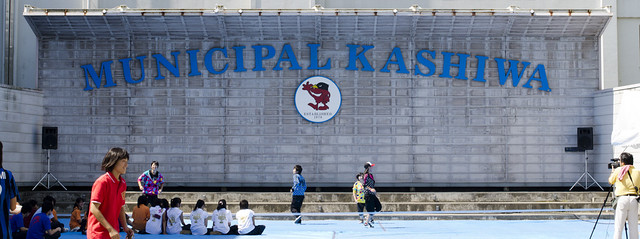
The Ichikashi campus is shaped like a ring, around whose center resides an empty lot and a stage. For most of the year the courtyard stands empty, save for the dozen or so cars that use it for parking.

Your entire tenure at Ichikashi will be this way: your work is your work and it is the very reason you are sent here, and it is the thing about which you will spend most of your time thinking. But the core of which, this large empty lot, is ambiguous space that you can fill and use as you wish. You can fill it with cars or junk or dust, or you can fill it with purpose and challenge. My only advice is to think about how you want to fill that space because that will help shape every decision you are likely to make, and how you will likely grow. Or not grow.

For all of its opportunities and all of its charm, no one in Kashiwa will make it a point to challenge you to remember to invest in yourself and your personal development. So it will be up to only you to ensure that you leave Ichikashi with anything more than just fond memories.

But, oh, what memories.

Ichikashi, Kashiwa: thank you for the memories. And I hope these won't be the last.

But even if they are, what remains is perfect.

Monday, March 24, 2014

Type Casting

At least four different people over the last four weeks have asked me to climb Mount Fuji with them before the end of the summer.

To them I quote a wise Japanese teacher I once knew: "Mount Fuji is for contemplating, not for climbing."

Sure, some people would call me lazy. To those people, I say: yes. Yes, I am.

Chances are, if we don't begin with samurai, ninjas, geisha or otaku, if I were to ask you to paint me a picture of Japan, you are most likely going to start with Mount Fuji (富士山). It is unquestionable that Fuji-san continues to have a marquee presence in Japanese iconographic culture, since time immemorial.

For centuries, the volcano was so sacred that for long points of its history no man was allowed to even set foot on the face of the mountain, with no first "official" climbing, as the stories say, being recorded until 663 CE by an unnamed monk.

But it was not until the capital was moved in 1603 under the Tokugawa Shogunate from Kyoto (京都) to Edo (江戸), with most people traveling the 53-stations along the Tokaido (東海道) Road, that the Mountain became a central feature of Japanese artistic identity. Traveling the road circumventing the base of Mount Fuji as they passed by the Izu Peninsula (伊豆半島), the mountain stood in stark contrast to the geographical and cultural flatness of Eastern Japan (関東). While Kyoto (京都) and Nara (奈良) had hundreds of temples and centuries of history to look to behind them, the citizens of Tokyo, instead, only had to look up to understand their place as the root of the ladder to the heavens.

Since the Meiji Era (明治時代), climbing Mout Fuji has been an exercise in discipline in the long tradition of Japanese ascetic practices
1There's a Japanese saying that goes 「一度も登らぬ馬鹿、二度登る馬鹿」, "It is only a fool who does not think to climb Mount Fuji once in his life; but only a fool climbs it twice."
1. The summit, which was once a sacred seating place for Kono-hana-sakuya Hime (木之花開耶姫), the goddess of earthly life, is considered a power-spot, upon which prayers can be more clearly heard and directly answered.

And while tourists numbering in the hundreds-of-thousands continue to climb the mountain annually, climbing Mount Fuji had not always been such an egalitarian affair.

For centuries, the holy mountain's 3,776 meter (12,388 feet, or ¥Ft.) ascent remained an unattainable pilgrimage to many due to such unfortunate afflictions as illness, injury, old age, cost, living in Kansai or just being born a woman
2It goes without saying that throughout most of history, as is echoed throughout most of Western history as well, women were not allowed to enter into sacred places of enlightenment in Japan--For as "the Lotus Sutra states: 'The body of a woman is filthy and not a vessel of the Law.' A woman could not attain enlightenment unless she was reborn as a man"--which would also include climbing to Mount Fuji's summit. This rule stood in place until an 1872 Meiji edict abolished such restrictions nationally at all shrines and temples.
2.

Anyway, for those not bold enough to challenge the rules outright or those not physically or fiscally able, as a nearly mandatory spiritual pilgrimage, ingenuity abounded.

One of the more ingenious work-arounds was the creation and proliferation of 富士塚 (Fuji-dzuka): local-sponsored miniature representations of the Sacred Mountain.


From One-Hundred Views of Edo, by Hiroshige

Usually services of the Fuji-ko pilgrims (富士講), devotees constructed replica Mount Fujis out of stones or plants brought back from their sojourn to remember their experiences by and share their enlightenment with those from their town who were not as fortunate to go
3As a sort of advanced-level omiyage (お土産).
3.

Often never taller than 12 meters, these mounds consist of simple faux-mountain trails complete with block-lava stones, hand carved "lava-caves" and shrines, and are adorned with plants similar to, if not exactly, the ones found sparsely dotting the side of the rocky volcano's face. Often, Fujizuka feature summits with picturesque views from which the holy mountain can be viewed and contemplated. Or at least used to, before all those pesky apartment buildings got in the way.

Interestingly enough, most Fujizuka even host local festivals and ceremonies that echo the tradition of Mount Fuji itself, like the one at Shinagawa Shrine (品川神社), which celebrates an Opening Festival on July 1st, "Just like the one at the real Mount Fuji." Or so they say.

Un-cite-able sources claim there to be more than 50 Fujizuka remaining throughout Tokyo alone, with hundreds strewn across Japan as far south as Osaka (大阪) and Kobe (神戸).

And while I have not yet made any plans to visit any of the purported "hundreds" of Fujizuka, I am 100% certain that, after a quick Google-search, I have actually been to more than a dozen on accident.

Heck, there's even one 30 minutes away from where I live, in Nagareyama...

Monday, March 17, 2014

Urban Planning

The whole affair spread out over the table like a thieves’ ransom; plates of reds, greens, browns and golds stippled the table with color, enshrouding the room in a rich, enticing fragrance. And while the meal was hardy and bountiful, it did not leave us feeling heavy or overindulgent.

The central feature was finely fried tonkatsu (トンカツ) over a soft bed of pearlescent rice, nestled against a shallow hill of slivers of cut-cabbage, accompanied by sides of aromatic, cloudy miso (味噌) and crisp, refreshing takuan (沢庵
1Interestingly named after a famous Buddhist philosopher/monk, Takuan Soho.
1). The meal was served in classic 和風 fashion, on lacquered trays and Japanese clay-work bowls with hand-shaped chopsticks, whose richness paled in comparison only to the marbled, succulent cuts of meat.

While famous for their choice pork, まい線 (Maisen) is also renowned for their impeccable fry-timing, making the breading on both their filet and roast cuts light and savory, with only the slightest hints of oil lingering on the lips. Meaning that by the time the dessert sorbet arrived, the light, barely noticeable essences of orange rind and vanilla were not lost in a glaze of grease, but offered a subtle contrast that helped ease us in our descent from the heaven of the pork-gods.

It was by no small chance that we happened upon Maisen for dinner. Enshrined across the internet by locals and tourists alike, this bath-house-turned-restaurant lost in the winding alleys of Omotesando (表参道) has become the go-to exemplar to illustrate the proof of value the Japanese put in process to guarantee results. How, through painstaking exaction and attention to detail from farm to table, even the lowliest, most common of foods can be raised to sublime levels.

The lightness of the meal lent itself handedly to the conversation around the table. "This was so much fun," we agreed. "How come you don't come out to Tokyo more often? We could do this every week," my friend continued.

Well, besides the fact that such "attention to detail" also includes an attention to the "bottom line," with a starting price of around ¥$35 per basic prefix set.

"I don't know," I mused, fully knowing why. "I suppose it's because I've already done so much in Tokyo that I'm running out things on all of those 'must-see' lists to must-see."

"Oh, okay," he assented. "Do you think you're done with exploring The City, then," he asked genuinely, while still managing to fully emphasize the capital letters in both words.

While I am sure that there are still an infinite number of things to find and do in Tokyo, I find it entirely impossible to conceive of randomly wandering around The City in the hopes of finding something to explore. It's already impossible enough to find places when I have the address and a smartphone to help me navigate the city.

It's not that there is nothing to do or find. But rather there is so much to do and see in the miniscule that it becomes overwhelming to try to find it by chance. I mean, all it takes is just one quick glance down any urban street in Japan and you'll see for yourself how a proliferation of information makes finding any relevant information possible. Which also seems to be the Rakuten design model, suggesting that it is a persistent feature in the Japanese conception of liveliness and commerce (akin to how shopkeepers, chefs and waiters alike yell at their customers when coming and going: 「いらしゃいませ!!」anyone?).


Even in Kashiwa, it is virtually a drowning-man's game in trying to find a worthwhile restaurant on a whim. Not for a lack of available storefronts, but rather because each and every four-story building is crammed full of izakaya (居酒屋), nabe (鍋) or gyudon (牛丼) shops, complete with a wall of neon signs and billboards, whose vague and poetic kanji leaves even the most academic of Japanese experts confused and unclear. Which does not even speak to the proliferation of shops with dubious provenance and a general lack of rigorous cleanliness standards. Any tourist who walks into a shop blind must expect to be brave on any number of levels.

That and the fact that Japanese people tend to line up for restaurants just because there was the makings of a line to begin with. Literally, I have asked people lined up in front of a restaurant what they were waiting for only to be told that they weren't particularly sure.

But this is how I ended up at a little hole-in-the-wall karaage (唐揚げ) place after wandering around down by the station while running some errands
2
2. No sooner had I poked my head through the smoke-covered glass sliding doors than I found myself drinking a plain, piss-yellow Japanese lager over what may have been one of the more delicious pieces of chicken I had yet tasted in Japan.

I suppose for any store that has been around for more than 25 years, and this shop and its keepers looked it, you’d think that they must have been doing something right. And this karaage was all right.

Except that the yakitori was a wash. A real, hard, disappointing wash. Though the iced-cucumber was refreshing, if not as salty as bar-counter cucumber should be.

But what this story really is about is how I was out running some errands in the city
3Not “The City,” but “the city.”
3, found a hole-in-the-wall, got a little drunk, went grocery shopping, and somehow came home with ¥$20 worth of crushed red peperoncino, bottled salsa, and 飲むYogurt.

On a whim.

So let it not be said that urban adventuring is dead.

Monday, February 17, 2014

Show Me the Logo

A while ago, way back when I was living in Boston, a friend of mine introduced me to the blog of a trainer (applied kinesiology and biomechanics) named Eric Cressey. Of all of the things his research has shown, I have found the things he has written about coaching theory to not only be helpful in exercise, but in my teaching methodology as well
1Perhaps, over the years, the only thing I've found more useful in figuring out how to deal with high school boys has been the work of Cesar Millan, the Dog Whisperer.
1.

One of the things that Cressey has written about at length is the value of having effective "Focus Cues" for coaching. That is, when an athlete is preparing to perform (or in the process of performing), what sort of verbal instructions should a coach offer to his/her athlete as either instruction or reminder that would lead to proper execution. Cressey, himself, has suggested various combinations of direct, explicit instruction (“tuck your elbows”) to the more memorably poetic (“imagine your hips are being pulled by a rope”). But recently, while attending a Nick Winkelman training conference in 2013, Cressey had taken note of the importance of creating a distinction between internal and external focus cues.

While internal focus cues orient the body relative to itself--where the elbow is in relation to the body, or how the hips should be positioned relative to the trunk--external focus cues instruct the athlete relative to the space around them. Rather than reminding the lifter to “keep his chest up,” Cressey suggests that, “Show me the logo on your chest,” is a much more effective cue in obtaining the proper posture on a deadlift.

Unsurprisingly, this change in emphasis from internal to external cues has been beneficial in how we approach teaching speech mechanics to our students.


Over the past two years, Kashew and I have been trying to develop our Oral Communication class to be more relevant to the students’ assumed academic needs (both in terms of the international-course and general-course content). But regardless of our expectations of use, pronunciation ability remains a highly rated perceived-need among students and administrators, despite the fact that most ESL students we encounter already speak with a satisfying degree of articulation.

Fortunately, for us, we found in the back of our textbook an extensive
2And useful, which is surprising because these two things are not always mutually inclusive.
2 collection of pronunciation assignments that we could easily adapt and supplement. From those basic assignments, we created an outline that would take the students from listening and speaking to writing and speaking, and then to reading and speaking with mechanical instruction (oral first, in terms of hearing and speaking, and then phonetic second, in relation to the reading and writing) as the transition between sections.

Up until recently, most, if not all, of our mechanical cues had been internal: where the tongue needs to be in relation to the palate to create the r versus the l sound, or where in the throat or nose the utterance should originate.

We carried these indiscriminate cues, which had seen palatable success among the high school students, into an intensive color-pronunciation lesson we taught at a couple elementary schools we were assigned to appear at last week.

Our goal was to teach them some basic pronunciation tips for a very specific set of words that they could carry into their continued acquisition of vocabulary, so they do not become trapped in or limited by their understanding and experience of English solely as Katakana-English.

Our cues primarily focused on internal pronunciation mechanics such as the placement of the tongue relative to the r and l of purple and the mechanical use of the lips in the production of the plosive-b in words like blue. However, it was very apparent from the very first lesson that such cues were minimally effective. However, cues such as the “sound of a dog’s growl” in producing the correct r in words like red proved highly effective.

As such, after our initial review, we dramatically shifted our focus from a mechanically heavy, internal-cue-based instruction to external cues like that above, especially cues that could incorporate hand motions for emphasis and would improve retention.

We began teaching the o for orange with a big “O” motion of the arms and then focused more on the popping motion of the lips like the flicking of fingers rather than the placement and timing of the tongue for the b in blue. We used a slow-drawing hand-motion to simulate the location for the production of the softer sounds for purple, and a smiling face to emphasize the long-iː of green.

We saw results almost immediately upon these corrections to the lesson plan.


In 2001, Gabriele Wulf and Wolfgang Prinz argued that external focus cues were more effective than internal focus cues in the improvement of motor-skill performance due to the “Constrained-Action Hypothesis.” This theory suggests that internal focus cues are psychologically constricting because they cause the learner to pay too much attention to the mechanics of his or her performance.

“An internal attentional focus constrains the motor system by interfering with natural control processes,” they argue, "whereas an external focus seems to allow automatic control processes to regulate the movements." Internal cues, it is suggested, affect their change by asking the learner to “stop” one action in favor of another, meaning the learner is more likely to become “frozen” in an attempt to control their movements, as this San Diego State University study (Effects of Attentional Focus on Oral-Motor Control and Learning) exemplifies.

Internal cues, it is hypothesized are akin to asking a subject to "not imagine an elephant," while external cues are more along the lines of instructing the subject to think about a strawberry, instead, to achieve the intended result. This same study finds a half-reduction in the amount of “absolute errors" committed during an Iowa Oral Performance Instrument test between the group instructed using external focus cues versus internal.

Wulf and Prinz go on to find that, "The effectiveness of instructions could be enhanced by manipulating the learner's focus of attention" away from their body to focus on the effects of their movements (649). In fact, "by increasing the distance of the movement effects from the body, the advantages of an external, relative to an internal focus, seemed to be more pronounced," in both result and retention (651). They theorize that an external focus point too spacially close to the body may be psychologically indistinguishable from the body, and therefore indistinguishable as an external focus cue. Much like how beginner drivers are instructed to cast their vision farther down the road in order to drive straighter.

However, observing a coach model the same mechanics (and, potentially even seeing a video of themselves performing the same mechanics) seems to qualify cognitively as an external focus cue by removing the mechanical instruction away from their body as they are more able to clearly see and focus on the effects of the mechanics.

These hypotheses make a lot of sense to me as internal focus cues require an advanced level of body-awareness and discipline, while external cues replace such control and awareness with spacial recognition. I would be interested in seeing whether or not external cues were more- or just-as- effective as internal cues among advanced learners/athletes, or people with much more body-mechanical awareness and control.

It would seem much easier, anecdotally, for an experienced athlete to respond efficiently to simple internal cues such as, “Keep your elbows tucked when you’re under the bar,” because his/her experience set indicates that they would be familiar with the formal image and proper feeling of the technique without getting caught up in processing the individual mechanics.

And then, while much more advanced, when understood in relation to their eventual effect, internal cues lend themselves much more to abstraction and broader application, whereas external cues, themselves, are already metaphorical abstractions of the internal principle and must be tailored to the learner and become constrained by the context.

Regardless, I look forward to testing the effectiveness of making conscious distinctions between the types of cues I use in class and in my own studies.

Thursday, January 16, 2014

The Way This Wheel Keeps Working

Yo, Nick!

Before we begin, Kashew says that John Mayer is going to perform at 武道館 relatively soon. Tickets shouldn't be too expensive. I figure that if tickets to see Fleet Foxes at AgeHa ran ¥$70, slapping down one or two Fukuzawas for a couple of tickets to bask in the radiant countenance of #MayerFace wouldn't be unreasonable.

So, let's do this.

Every year since 1995, the Japanese Kanji Proficiency Society (財団法人日本漢字能力検定協会) hosts a national ballot to select an annually representative Kanji of the Year (今年の漢字). Over the last 18 years, kanji depicting everything from major disasters and war (災 - sai, 2004; 戦 - sen, 2001) to life (命 - inochi, 2006), love (愛 - ai, 2005) and relationships (絆 - kizuna, 2011) have been chosen.

This year, among the nominees were kanji representing the celebration (楽, 喜) of the return (倍) of the strength of the Japanese economy (富) and the Japanese way (東, 風). However, by a narrow 0.56% margin, the committee selected 輪 (rin/wa)
1
Source: 47news
1wheel—to epitomize the spirit of 2013.

Voters noted the cyclical nature of economics and the completion of large-scale building projects and the consolidation of corporate programs as images of oneness and wholeness, as well as the eventual reward for patience and diligence as best typified by a simple wheel.

But overwhelmingly, respondents pointed to the kanji's second reading of ring and Tokyo's successful bid to host the 2020 Summer Olympic Games—a parallel to its symbolic five, interlocking rings—as representative of Japan's return to the international stage.

As a critical, end-of-the-year exercise, I particularly enjoy this one. With all New Year's activities, this activity helps create space in which we can look back on our year and place ourselves, contextually, within a larger understanding of growth and change, personally and socially. But by anchoring the self-assessment to a tangible product, the goal of writing kanji becomes a focal point that gives the exercise direction and creates a touchstone for reflection from which to begin to think about the coming year.

今年の漢字 has become one of my go-to topics for English conversation classes and one reflective exercise that I genuinely enjoy participating in and doing for myself. It is also one that we started making our third-year students do in January, their last month at school before they begin their two-month 'college preparation' period. We require them to brainstorm about the three most important events over the past school year and then pick the kanji that best represents their experience as seniors.

For their 今年(度)の漢字, many students pick 恋 or 愛 to signify newly founded relationships borne out of club retirement. Some go with 全 or 最 as the culmination of their years of work, or 自 or 選 for the hard fought freedoms that come with graduation. And some select 働 or 進 to signify the perpetuity of a body of work not yet finished.

To describe her senior year, Izumi picked 戦, battle, while Kayo went with 頑 because gan represented the firmness and stubbornness required to survive. Similarly, Yuka opted to go with 疲—exhausted, tired or weary—to illustrate the overall stultification of senioritis. "It pains me even to think of it," she writes.

On the other hand, Masahiro chose 初, beginning, because 2013 was the year he caught his first fish and set a new personal record in track-and-field, which allowed him to compete in the Takeyaryou Tournament for the first time. Sho also signified a new beginning for him, as he was able to pass his entrance exam to Dokkyou University.

Yuki selected 大 for all of the big things he did and Shunya picked 成 because of the ways he felt he grew throughout the year.

For me, I would probably choose 挑
2ちょう 【挑】 - chou
[常用漢字] [音]チョウ(テウ)(呉)(漢) [訓]いどむ
相手に行動を仕掛ける。いどむ (itomu)。「挑戦・挑発」
2, challenge, to summarize the way we approached and accomplished unexpected presentations and speeches at work, the 頑張れ-spirit of new hobbies and extra-curricular activities, and the mindset with which I will approach the last few months of this school year before I start wrapping up my final term here at Ichikashi.

At which point I hope to have a whole different set of kanji to choose from.

Monday, December 2, 2013

My Favorite Sport (SJ: 12/02)

三年生 - Elective
My favorite sport is swimming.

Come summer, I swim in the pool every day.

But I don't watch a swimming races on TV. I am not interested that much.

But I like to play in the water. When I swim, I feel that the flow of the water feels good and I can forget about my daily life because, in the water, I don't hear the noisiness around me. It heals me.

An important thing, though, is not to drown. Because the first thing, living is important.

Wednesday, November 27, 2013

The Other's Other

A few months ago, after the gold medal match of the World Cup of Softball between USA and Japan, ESPN commentator, Michelle Smith, was heavily chastised for a stereotypical "rice and sushi" joke about a Japanese fan in the stands dressed in a happi coat, which, to be fair, is the standard uniform for men in traditional 和風 related fields, today most commonly found in Japanese dining.

While I actively advocate for the necessity of pointing out individual behaviors and complex systems that perpetuate racial assumptions, I wondered how the dynamic is altered if the appropriated culture, itself, participates in the perpetuation of its own stereotypes.


Because stereotypes have the power to flatten cultures into homogeny, Japanese culture, which has a history of eschewing roughness in favor of uniformity, has become a society which happily trades and is heavily invested in its own stereotypes. It is no accident that ideas of "sushi" and "samurai," "geisha" and "ninjas," robots and technology are quintessentially "Japanese." Even though many households still lack computers, the Japanese, themselves, would say these things to you, even without your asking. Much of the uncritical, national-personal identity is tied up in ideological "samenesses," not limited to appearance, taste or personal philosophies.

But then, of course, such broad, sweeping statements as the one above are flattening and problematic as they don't take into account individual dynamics.

But when those self-same individuals appear invested in these stereotypes for their identity, especially ones that create and perpetuate differences from other local cultures, how much are we to blame as outsiders for participating in those artificial binaries?


Japanese Americans have long benefitted in trading in traditional American-minority stereotypes. As a secondary group of non-indigenous "others" in an otherwise standard majority-minority binary, Asians come out ahead of blacks by merely being a contrasting difference
1Simply by not being first, but also, importantly, as non-diasporic, financially and culturally affluent expatriates
1. Like trying to locate a third color in a binary gradient, "yellow" fits fluidly between similarity and dissimilarity because while it is not "pure white," it also passes as definitely "not black."

Taking advantage of the existence of a contentious white-black binary, Asians submitted themselves as an accommodating “model minority"; a triangulating pole against which blacks are judged as a problematic, failing minority group; “proof” that the hegemonic system worked.

This tension between minority "brotherhoods" grows even more when, because of the aforementioned fluidity of their otherness, Asians access and perpetuate culturally flattening black-stereotypes as emotional shortcuts to signify toughness, non-conformity, and, most heinously, solidarity, all of which exists outside of the Asian American reality because of their willful submission to the patriarchy.

It is no surprise, then, that Asian culture groups are in no hurry to overturn systemic racism, lest they put at risk the benefits they reap from being the other's other. And it is no wonder why other minority groups that suffer less favorably have little patience with their Japanese (and Chinese and Korean) counterparts.

But, regardless, cultural appropriation stings equally across races, as Katy Perry's performance at the November 2013 American Music Awards reminds. Appropriation, here, is when aspects of cultural customs and heritages are ripped from their cultural contexts in the service of pandering to larger stereotypes. In this instance, Katy Perry, in order to communicate the beauty of unconditional devotion and self-sacrificial submission, took from the Japanese the Maiko/Geisha, the embodiment of the Yamato Nadeshiko, the delicate floral metaphor of the ideal, pure female beauty, demure and unobtrusive, as codified in the Heian period as part of the 大和魂, the innate, indigenous aspects of true Japanese spirit, the traits that make up the very soul of Japan.

Perry's appropriation of Maiko and the Yamato Nadeshiko is problematic because it subjects Japanese (nee, Asian) women to a sexist, patriarchal submissive ideal, reducing their value to servility and beauty.

But to accuse Perry of appropriation feels a bit disingenuous when Japan still readily trades in such stereotypes. In thinking forward to the 2020 Tokyo Olympics, I have a hard time imagining that their Opening Ceremony wouldn't be much different than what was shown here. After all, famous in Japan
2"Japan-famous."
2 is Christel Takigawa's "Omotenashi" speech, used as the centerpiece of Tokyo's Olympic bid package, which, itself, has become more famous here because it is a pandering, pan-Asian mish-mash of koans (公安) and hand-gestures
3Spoiler alert: nobody bows like that here. And Christel does it twice in her 2 minute speech.
3 that spoke more to the orientalist constructs the IOC expected to see. In many ways, the entire Tokyo Olympic bid was a formal presentation of the post-apocalyptic, simulacrum-Tokyo that Tokyo (and its people) doesn't just aspire to be but actually believes itself to be. These images become powerful unifying forces that help give Tokyo (and all of Japan) a sense of grandeur, of purpose. But also smashes everybody into a seemingly faceless one-ness and interchangeability.

In many ways, it is easy to see how japan benefits domestically by perpetuating these stereotypes. But more importantly, as Japan has historically been afforded the unique position to control the terms of substantial portions of its own international image through exclusion and mystery, by investing and targeting specific stereotypes to emphasize, Japan has colored in its own paint-by-numbers narrative to positively contrast with the countries in its area.

Though the Japanese drink as much if not more than their closest neighbors, it's the Koreans who are seen as wild partiers. Though Japan heavily squanders energy on inefficiently recycling waste plastics for packaging and wrapping, they are thought of as clean and environmentally friendly in contrast to the Chinese. And while the mob-run gambling and sex-trade flourish throughout Japan, it's Tokyo, not Bangkok or Manila, that's "safe" and "free from corruption."

By holding tightly onto monolithic, hegemonic institutions, Japan has established itself as a stable cultural state, the icon of thousands of years of history and tradition, despite actually being much younger than its Chinese, Korean and even Southeast Asian neighbors. This despite the fact that many of the images we have of Japan weren't established until the Meiji Restoration in 1868.

On the one hand, it seems perfectly reasonable for people, like Perry, to reiterate the narrative pieces she hears, especially when they appear to come from credible sources
4i.e. the Japanese themselves.
4. And, when lacking in exposure, ignorance is understandable. But at what point do we start holding people accountable for their ignorance?


The other day, a friend and I met an international student over coffee. Over the course of normal conversation we came to find out he was from Senegal. In a later debriefing about our interaction, it came to light that my friend had plenty of questions he wanted to ask the international student about his home life and his family, but my friend was unsure about whether the questions he wanted to ask were insensitive or ignorant because of our general American unfamiliarity with all-things-Africa.

I affirmed that this was probably the best course of action in this situation. But that, were we to meet our new friend a second time, such persistent ignorance could be seen as nothing short of willful and offensive in its indifference.

Everybody deserves at least that much, right?

Tuesday, November 19, 2013

Land of Opportunity

I always intend to go to bed as early as possible. Sleeping may just be one of my favorite things in the world, followed closely only by things like "eating" and "pooping."

But the best-laid schemes o' mice an' men, as they say, gang aft agley. And with the likes of Maru, Stack-cat and Nya-Suke on YouTube, I really have no chance of getting to bed before midnight.

Things never go quite as planned. This is especially true when you’re relying on other people’s motivation for success.

Rocketship Park


A few weeks ago, 2A-Oral Communication left for their Language Training excursion in Torrance, CA. And every week leading up to that since mid-spring, Kashew and I were tasked to provide the students with conversational and cultural instruction that would be beneficial to their experience in America. And though, early on, because the trip seemed so far off in the future, they would struggle to pay any attention to what we had to say, by the time it dawned on them that they would actually be flying to America, they felt under-prepared and overwhelmed by the burden of international travel and cross-cultural interaction.

Over and over again, the students would tell us that they were embarrassed that they could not speak English like a native speaker, that they were afraid that the Americans would think that they were dumb and ignorant about many facets of American culture.

We would listen patiently, nodding in understanding, having shared acutely our own daily experience with the very stress they dread, from shopping at the convenience store, to ordering dinner, to getting haircuts, or trying to schedule weekend activities. No matter how much Japanese we learn, no matter how Japanese we may feel, there are always aspects of Japanese culture that we are not yet privy to, in a way that makes cross-cultural understanding seem more like sifting through quicksand than checking off lessons listed in a textbook.

But, on the other hand, I want to yell at them. What they were dreading was the prospect of being uncomfortable, the mere "likelihood" of misunderstanding. Firmly rooted in their fear of unknowing, I want to shake them out of their risk-adverse hesitancy because, guess what: Surprise!, they aren't native English speakers and, double surprise!, they don’t know anything about American culture. And double-plus surprise!, their host families already know that.

But, as such, we tell them that this is their golden opportunity to 遠慮しない, to act without reservation. That while international travel is scary and cross-cultural exchange is intimidating, a study-abroad trip is the time to explore those scary and intimidating things with as little risk as possible because everyone there knows you came to learn. So there is no shame in ignorance. There is no shame in not knowing. Because you came to learn.

So if they have a question, they should feel free to ask it. If they have a curiosity, they should feel free to explore it. Ask freely, explore freely: the host families sighed up because they want to share their culture as much as they want to learn about Japan.

So that should be our target framework.

Bumper

One thing that I wanted Kashew to be conscious of as we designed our 2A prep classes is that our goal should be to remove the barriers that the 2A students may face when going to America. We want to facilitate the cultural exchange experience. So whether that be by lowering stress levels by teaching students how not to get lost or "randomly selected" for inspection by TSA at the airport, or teaching them about refrigerator rights or how Americans join the toilet room and the shower room in one, all-encompassing mega-room called the "bathroom," our target is to prepare them for their stay with their host families, because it is their experience with their host families that will teach them more about culture and the value of exchange than we ever could.

We want to facilitate the cultural exchange experience, not replicate it or replace it.

Rather, I believe that if we teach them everything there is about American schools and American eating habits before they leave for America, we're taking valuable exchange experiences away from our students and their host families.

I don't care so much to give them the answers to all of the questions about America before they get there. What I want to teach them before they go is how to ask those questions of their host families and then have to be asked those same questions of themselves.

So we teach them how to talk about their opinions and express their desires. We have them practice how to ask and then listen to the answers. We show them some of the things they will see and do in the hopes that they will start thinking about what they will experience and what they can talk about. All in an attempt to reframe their approach to the exchange program from "risk" to "opportunity."

But no matter how many times we yell at them not to be afraid to take the chance and use their English, that is a decision that they have to make. One we hope they decide to make before they go to America, and not on their way back.

Monday, November 4, 2013

Advice to 2A (SJ: 10/29)

三年生 - A(1)
Hello 2A,

I heard you are going to Torrance soon. I am [Takuya] in 3A. I want to share some advice.

At first, be careful with your baggage and valuables in travel because I lost my hotel key at Griffith. So you should always care for your baggage and valuables.

Second, [Akira], you are a playboy so you shouldn't pick up a girl. You must defend this rule. If you break this rule you can't come back to Japan.

Finally, when you go to Torrance, you should talk with many people. And then you can make many friends and have the best time. God bless you!

I hope my advice can help you. Please enjoy your travel.

Wednesday, October 9, 2013

The Content of Character

It was the first time in five years that I had seen her. I wanted to say, "I missed you so much, mom"; "I am so happy to see you again," but the sentences wouldn't come out of my mouth. They felt trapped, like a ball of cotton sticking in my teeth, making it hard to breathe.
Hey Nick, long time no e-.

That little snippet above is our entry from this year's free-speech contest. It's the introduction to the emotional crisis that we would spend the next four minutes trying to resolve. But, from that, if it's not obvious: we did not win, because, duh.

If you think about it too much
1And I think maybe I do.
1, writing the speech is probably the easiest part of preparing the students for a speech contest. Well, the actual writing, itself, is of course an unceasing labor, first in trying to understand the content, then in trying to understand the speaker because, ultimately, speech writing is about helping the student say what they want to say in the ways they want to say it if only their grasp of the English language were better. But once the speech has been sent to print, since the text supposedly speaks of their heart, it should be no extra work to get them to invest in performing the content.

In lots of ways, helping students pick materials for the Recitation and Reading divisions is much more challenging for me. And even once the material has been picked, I can't help but stress over whether or not the material is at the appropriate level for the speaker and for the contest.

That is why even before I begin, we get together to lay out a Map of Success for the students. The Critical Theorist in me requires that we clearly articulate objectives for the speech contest and define what we are going to consider a 'success' and what is a 'failure.'

For some of our students, merely participating is the target, so then 'participating well' is our goal. For other students, we have much more specific challenges, such as oral mechanics or level of difficulty of vocabulary or grammatical patterns that we would like for them to develop.

And while 'winning' is a definitely a consideration, I do not like making it a significant marker of success because there are so many variables to placing that are so far beyond our control. After all, though winning is 'the point' of the competition, what if we perform admirably but the level of competition happens to be unusually high that day? Was that a waste of time? Or, conversely, if we perform abysmally, but the level of competition is low and we win, do we consider our preparation and execution a 'success,' or anything more than just being really lucky? Or what if the judges are 'bad' and judge according to criteria that is beyond the scope of the rubric of the contest
2*[Cough, cough]*
2?

It becomes paramount to not only recognize that in judged competitions, sometimes it is not always what we do right or wrong, but about what the other contestants do and what the judges see or do not see.

All we can do is make sure that we produce a speech--in content and delivery--that is comprehensible and compelling.

So, with an eye towards our mutually negotiated terms of 'success,' in picking the material for our recitation and reading, there are a few key factors that I want to consider: in order for the student to want to spend hours and hours working on the minutia of mechanics, the text needs to be emotionally engaging and offer points of personal investment; likewise, in order for the time spent to be a worthwhile learning experience, the text should be sufficiently challenging.

Similarly, since I will have to listen to the student recite the speech for weeks on end, it has to be a text that I find worth listening to.

And yet, and yet, sometimes I don't know if the challenge is worth the risk. Maybe the text is too hard to memorize, let alone understand. Maybe the text does not accurately showcase the students' talents or strengths. Or maybe the text does not line up with what the judges expect or come prepared to hear.

2013-09-23_Yamagata007

One of our students is a girl from Peru: smart, charming, and a very competent English speaker. We did not particularly have any students in mind when trying to select who to ask to do the district speech contest, and so it was by great fortune that Naomi stepped up to the challenge. It was as if she fell into my nets, a giftwrapped treasure from the gods set afloat down the stream. And so when she drifted along she seemed to be the perfect pair to a text that had also, out-of-the-blue, jumped into my ship three months earlier.

Now, I'm perpetually on the lookout for new material, but it seemed to be a particularly divine turn of the Wheel that I stumbled upon a not-too distant episode of Radiolab that happened to feature a story from Cosmicomics.

"The Distance of the Moon" is a 1965, translated text written by Italian neo-mythologizer, Italo Calvino. It is a beautifully written tale based on the premise that at one time the earth and moon were much closer to each other than they are now: so close, in fact, that all you had to do was prop up a tall ladder and you could find yourself on the cool, cream-colored surface of the moon.

The text, written in an oral, folk-tale style, is challenging in its conversational tone, in addition to its advanced vocabulary.
On those nights the water was very calm, so silvery it looked like mercury, and the fish in it, violet-colored, unable to resist the Moon's attraction, rose to the surface, all of them, and so did the octopuses and the saffron medusas.
Despite being quite conversant in English, the text was hard for her to read aloud and its meaning obfuscated by the extremely casual structure. But that very tone and rhythm helped to create space for some strikingly beautiful prose:
...or else we contemplated the stars beyond the Moon, big as pieces of fruit, made of light, ripened on the curved branches of the sky, and everything exceeded my most luminous hopes, and yet, and yet, it was, instead, exile.
It is difficult to read. It is a bit lilting and heavy of heart. But its hopeful richness and wonder is a tone that matches Naomi to a tee.

It was a risk because I was not sure if Naomi would be able to master the text. But, most of all, it was a risk because I was not sure that the judges would understand the context of the presentation as a break from the stilted political stump form. Would they be open to a dynamic, oral interpretation inspired reading?

And, unfortunately
3As the Wheel is wont to turn
3, I am thinking that they did not.

It was, by far, the most technically complex text in the entire speech contest. It was also the most interesting, with its emotional depth and literary beauty. But it is hard to say if I set Naomi up for success with the piece that we picked.

However, I do know that I would have been disappointed with myself if I let us pick a 一年生英語 Reader level text
4Anyone interested in a fourth or fifth rendition of "Stay Hungry, Stay Foolish," or "I Have a Dream"? No? Okay, how about "The History of Ice Cream," or an excerpt from the Disney Storybook Collection?
4 like everyone else.

Anyway, it appears that any text that asks the judges to listen to the content to understand changes in tone or emotion, let alone challenges them to listen to a student speak at near-native pace, is a little too much to ask for. I guess I will just have to dust off my old copies of Big Dipper or Mainstream if I want my kids to get past the district round.

Friday, September 27, 2013

The Path of 10,000 Stones

When I got to Boston, I found myself enrolled in EN844: Medieval Mystics.

Now, this was hardly my first Medieval Literature course. In fact, I have had a long, tantric love affair with Medieval Literature that included a self-hating course
1Me, not the course.
1 in Beowulf, in its original Old English.

And so in reading the texts of the Medieval Christian Mystics, that these people would struggle to come to grips with their humanity was not so surprising. What was amazing was the lengths they would go to apply the critical theory they espoused in an attempt to transublimate the divine they found inaccessible in everyday life.

These people would veritably tear up the floor boards of their being to examine the bits and pieces of their soul. Their austere lives took, piecemeal, their psyches, removing it from its whole to scrub its parts until it lustered, getting to know every nook and cog, coming to know, intimately, the function of its pieces and begin to see the potential in the machine. The processes of prolonged fasting and physical and emotional self-flagellation laid bare the shape of their souls in the hopes to purify their vessel adequately to become a receptacle for the divine.

This is hardly a phenomenon unique to the West. Nearly every moderately developed religion produces sects of ascetic practitioners whose bodies of work leave indelible marks on the landscape of belief.

2013-09-23_Yamagata016

In the late 6th century, Prince Hachiko (蜂子皇子), the son of Emperor Sushuo (崇峻天皇), began a religious journey of self- (and political-) rediscovery as he fled the Soga clan (蘇我氏) from his home in the capital of Kyoto.

Having made the 700km journey from the opulent, steamy West of Geishas and tea houses to the austere, frozen, barbarian lands of Tsuruoka in Yamagata (鶴岡市、山形県), his diligence was rewarded with a vision from a three-legged cow, who came as a messenger from the gods: climb Mount Haguro (羽黒山), and there, purify yourself and you will find the enlightenment which you seek.

At the top of Mount Haguro, as one deposed and in exile, he would dedicate his life to rigorous ascetic pursuits and later establish a shrine, Dewa Sanzan (出羽三山), and two more subsequent shrines at the nearby summits of Yudono (湯殿山) and Gassan (月山), where he would achieve the climax of his religious experience.

The Dewa Sanzan (both individually and as a unit) persists as a testament to ascetic religious experience. Even today one can make the arduous three day pilgrimage (お遍) to the three sacred power-spots (霊山) in classic ascetic fashion, wearing straw sandals and the 浄衣 of the Shinto religious class. But if you’re not so hardy, as I tend not to be, one can take any number of buses to the summits of any three of the mountains, though it will cost you a hefty fee
2Public transportation: an ascetic practice all on its own.
2. From Tsuruoka (鶴岡) Station, each bus takes about two hours to its destination, but just the bus to the Yudono Information Center alone cost us ¥$18 each (one way).

These buses run limited service in non-peak season, meaning that they run fewer than once every hour (mid-day we had to wait four-and-a-half hours for a return trip from Yudono), but it would seem that even that could be considered part of the ascetic journey, if you were trying to be optimistic. That being said, if you’re going to go to Tsuruoka, book a tour: it seemed much more convenient and expedient.

Kashew and I only had time (and energy) to visit the lower two of the shrines, Haguro and Yudono.

They say that Haguro is the most easily accessible of the three to visit, as there is literally a bus stop at the shrine-summit. But what kind of experience is that?

The alternative is to get off the bus at the Welcome Center and take the leisurely stroll up the 2,446 steps to the shrine
3
2013-09-23_Yamagata015
3. And while most of those flights are near-vertical, if you take your time, I can see how the cedar lined walkways could be quite the romantic experience, as the sunlight stippled stones wind their way over calm streams and around thousand year-old, moss-covered shrines and pagodas.

However, dripping with sweat and being beaten up the course by three, spritely junior high girls, I found it to be soul-crushing and humbling.

At the end of the stairs is an active, well-kept shrine in the modern style, as you would come to expect from your tours of Japan. While the shrine itself is not particularly the image of divine contemplation, I suppose it is supposed to be the experience of getting to the shrine that is sublime.

Actually, we spent most of our time, while not gassed and embarrassed by 80 year-old grandmas with walking sticks, looking for the 33 ancient carvings in the stone walk way. It is said that if you find all 33 icons, your dreams will come true. But between age and random tagging in the stone facing, at best we found only 15 or so. But, in the fine tradition of ascetic monks everywhere, I figure that there are probably really only 15 or so etchings; a Magritte-esque slight-of-hand to suggest that if our vision is so narrowed by our selfish desires, we miss the transcendence of the journey. Or something like that.

Ostensibly, from Haguro, one makes the eight hour hike to Yudono, a power-spot famous as being the artesian root of the hot springs of Tsuruoka. Here, in AD605, it is said that Hachiko was inhabited by the Buddha and given the revelation that the Shinto gods were all avatars of the Buddha himself.

And, thusly, Yudono, though not the highest of the three shrines, is considered to be the most important to the Shingon Sect. So sacred is the shrine, in fact, that pictures are strictly forbidden beginning all the way from the 大鳥居 gate at the welcome center, 2km away.

After a short walk along a ravine wall and across a narrow, wooden bridge, you find yourself at a Shinto-styled station waylaid by a brown and red stone face that overlooks lush, green folds of pines below. There, at the gate, you must remove your shoes and complete the remaining five minute walk barefoot over stones, but only after a short purification ritual (nominal fee: ¥$5
4Of course a small price to pay for your soul
4). As sacred as the site itself is, the priests there say that your experience at the shrine is just as sacred and so should never be spoken of or even listened to.

Suffice it to say, then, though the shrine at Yudono took no more than an hour to see, it was truly a unique experience, especially to merely be witness to any Shinto ceremony, which tend to be rather exclusive in its familial intimacy (and cost)5. Of course, admittedly, at the end of the eight hour hike to and from Gassan, the one hour at Yudono could theoretically feel like a spiritual eternity.

But I’ll leave that to you asceticists. I have a bus to catch.

Monday, September 16, 2013

For What It's Worth

A couple weeks ago Kashew and I realized that we had an extended weekend coming up. In September, we have a couple of Mondays and Tuesdays off, but these are no ordinary holidays. Rather, they are mid-week CTO for Saturday in-service for Junior High Open House and Bunkasai, which meant that, if we felt so inclined, we could prepare a trip almost anywhere in Japan and expect tourist crowds to be at a minimum.

For a long while we’ve been eyeing a trip to Yakushima (屋久島、鹿児島県、九州), the UNESCO nature preserve off the coast of Kagoshima that is home to some of the oldest trees in the world, as well as the inspiration for the setting of much of Mononoke Hime, only the best movie Japan has ever produced.

In August, we found some really cheap ticket prices
1The influx of LCCs in Japan have really opened up domestic travel at around \$130 round trip.
1 and were getting set to drop some dough and go for a four-day retreat and 温泉.

But I just wasn’t sure. By our estimation, we would fly into Kagoshima late in the weekend and catch the 4-hour ferry (or 3-hour foil) out to Yakushima. Theoretically, if we were to get back to Kagoshima in time to see anything in Kyushu before catching our flight back to Kanto, we’d most likely spend a mere two half-days on the island itself.

Admittedly, after perusing the suspiciously short list of things there are to do in Yakushima, two half-days would seem like an appropriate amount of time to see a good majority of the things there are to see there. Except that of the four things to do listed on the Japan-Guide.com website, only one of them did not use the words “multi-hour” and “hike” in any sort of combination.

This created a dilemma.

Would it be worth it to spend the hundreds and hundreds of dollars and half-dozen hours it would cost to fly down to Kagoshima and catch the ferry to Yakushima only to really be able to say, ‘Yeah, I’ve been there,’ but not be able to say, ‘Yeah, I’ve seen that’?


"Cost" is an interesting variable, and one whose aspects have changed for me over time. Having grown up in a somewhat affluent area of Southern California, there have only been two distinct periods in my life where public transportation has played an important role in my every day traveling.

Back in 2005 or so, I used the extensive network of Boston Public Transportation to my full advantage, running from one end of Downtown to the other and, back and forth across the Charles by ferry or bus or rail on a daily basis.

At that time, what mattered most to me was not particularly the financial cost: what mattered most to me was time, which combination of transportation modes would get me from point-A to point-B in the least amount of time, regardless of back-tracking or line-skirting.

Whether there was any actual reason to be in a hurry was inconsequential. The mere shaving of minutes off of regular travel routes was its own point of pride.

And now whether it is that I have just grown somnolent in the last 9 years, but all of that rushing now seems so senseless and particularly pointless to me. My metric of value has shifted: no longer do those 3 minutes “saved” mean much of anything, especially if it’s a matter of spending 3 minutes in the train or 3 minutes standing on the platform waiting for the next train. What matters most in how I plan my travel itineraries now is “total number of transfers”: the total number of times I have to stand up, walk up the stairs and across the pedestrian overpass, and board another car, hoping to find an open seat.

If time is money, I have decided to cash in on comfort.

The 常磐線, the train route that services the greater Kashiwa area, has two lines, the Rapid and the Local. The Rapid stops at 8 stations between Toride and Ueno, skipping minor stations like Kita-Kashiwa, where I happen to live.

And while the Joban Rapid gets from Ueno to Kashiwa 20 minutes faster than the local, because I would need to transfer from the Rapid to the Local at Kashiwa to get to Kita-Kashiwa, it always gives me pause


This brought about the discussion of ‘worth.’ What does it mean that it would be ‘worth’ doing something?

The negative way of thinking in this situation seemed to be along the lines of opportunity: “When will you ever again have the opportunity to go,” especially if this is my last year working in Japan. As an opportunist, it may be surprising to think that this approach could be classified as negative. But, ultimately, the question is asking, “How will you know if you will ever be able to have this chance again?” which, to me, is a negative way of looking at opportunities of agency. The counter question is, “Why do you assume that I would not be able to go if I no longer lived in Kashiwa?”

The true opportunity is one of convenience, not of availability. And while every opportunity must be weighed against its cost, opportunities of convenience must be weighed against future cost + potential inconvenience.

Presently, the convenience offered is exclusivity (being a small minority on holiday at the time) and assured proximity (traveling from Kanto to Kyushu is much closer than traveling from LA to Kyushu, though next year I may very well find myself in Kansai, which would be a decrease in potential inconvenience).

The necessarily incurred inconveniences by taking advantage of this opportunity are our time limitations and travel fees plus incidental costs, such as the fact that my MacBook Pro just died and will have to be replaced at great expense within the end of the year.

At this point, the variables have become confused. This begs me to clearly articulate my analytic metrics: the one we will use in this instance is cost versus potential enjoyment against the cost of deferment.

This geometric theory can be summed up by asking, “Will I enjoy[Ʃ]: X(activity) for Y(amount of time) at Z(cost) more than [Replacement Activity]?” It’s the VORP of travel planning.

In the Yakushima Intiative, it appears that the sole variable in question is that of Y: time. The amount of time we have allotted would likely diminish the amount of potential Ʃnjoyment of said experience. Or would it?

Could anybody guarantee the greater amount of fun Yakushima would be if I had 2, 3 or even 4 whole days on the island? Or, incidentally, could that risk be mitigated by increasing the amount of time we could spend hanging out in and around Kagoshima before or after?

Presently, I would be inclined to say that at the current expected cost, such an improved outcome would be likely with more time to relax. So it would seem that deferring the trip would be preferable, despite the potentially great possibility that no opportunity to go would arise the longer I wait
2Though as an actionable situation, the variable of Will will ostensibly tilt the equation. One of my Statistics pet-peeves is the tendency to treat actionable situations as if they were random occurrences, and therefore suggest that statistics are predictive rather than indicative.
2.

However, even if Yakushima scores lowly with the present metric (Event[Experience; Opportunity; Company; &tc.] :: Cost[Time; Money; Energy; &tc.]), within the immediate context, is there anything better I would be doing with my time than going? Finally get around to touring 青森県? Maybe even 福島県? Four consecutive days of 焼き肉食放題? Four consecutive days of 柔道? Four consecutive days of sitting at home alone and watching TV?

Despite having an overall lower ceiling, all of these other activities also happen to have much lower costs and, therefore, much higher likelihood of satisfaction associated with it. Thusly, not going to Yakushima seems to have a greater likelihood of resulting in Ʃnjoyment.

However, this is only so if I actually make other plans.